You just spent real money on several pallets of premium St. Augustine or Zoysia sod. The first three days, it looks like a magazine cover. By day ten, you notice a yellowing patch near the fence. By day thirty, your investment is crunchy, grey, and pulling up like a loose rug. This is one of the most common frustrations we see in Houston lawns—and it happens more often than it should. The reality is that why new sod fails in Houston usually has nothing to do with the grass itself, and everything to do with what happened before the first sod piece was ever installed.
New sod fails in Houston most often because the underlying problem was never identified before installation. Whether that's a drainage low spot, compacted Black Gumbo clay, or a pH issue that no amount of good prep can overcome, skipping the diagnostic step greatly increases the risk of a short-lived lawn. Fix the root cause first. The sod comes second.
If you're already planning to move forward with new grass, you can learn more about what a professional install involves on our Houston sod installation service page. It outlines what goes into proper prep, installation, and setting the lawn up for long-term success.
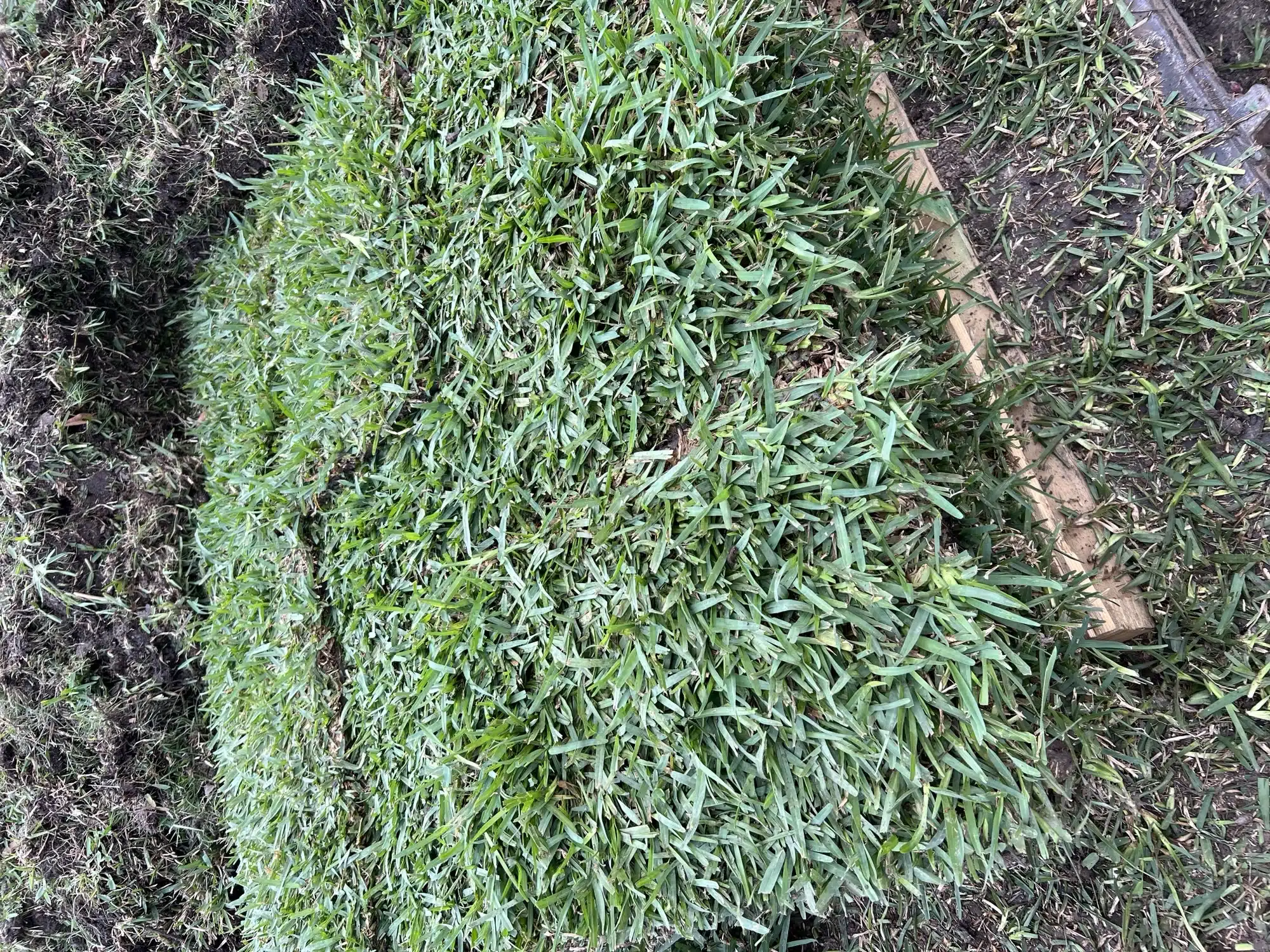 Fresh St. Augustine sod can give a lawn a strong start, but the soil and site conditions underneath still determine how well it establishes.
After working on lawns across Houston for years, we’ve seen how small site issues can turn into expensive failures when they’re missed early. This is where most people go wrong: they see dead or thin grass, order sod, soil, and tools, and go straight to installation. Three weeks later, after the next heavy rain, they’re standing in a puddle staring at the same problem—except now they also have $3,000 to $4,000 and a lot of wasted time tied up in the project.
Before a single piece of sod touches your yard, you have to ask one honest question: Why did the grass fail here in the first place? The answer will tell you whether you have a solvable prep problem or a structural yard problem that prep alone cannot fix.
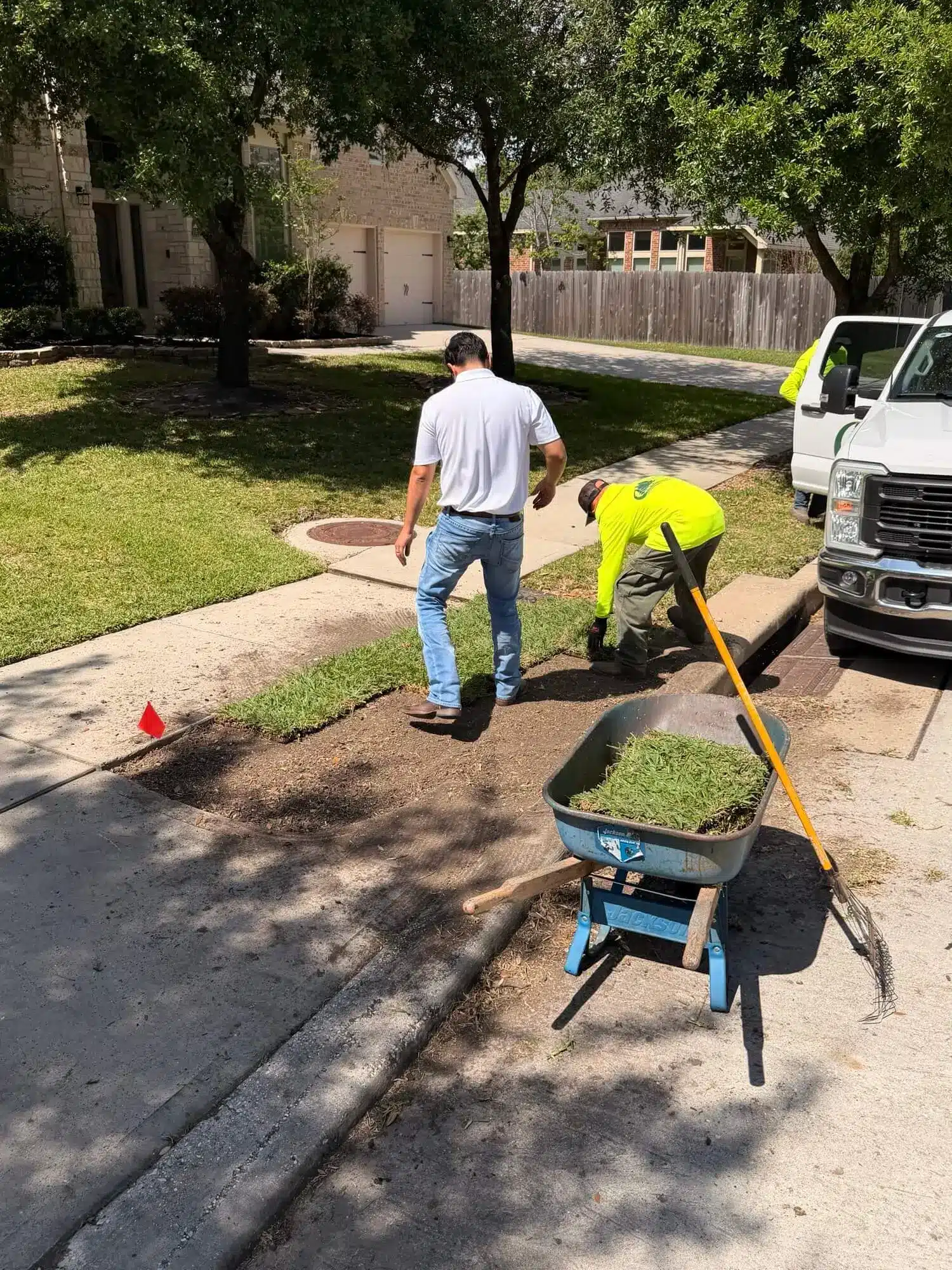
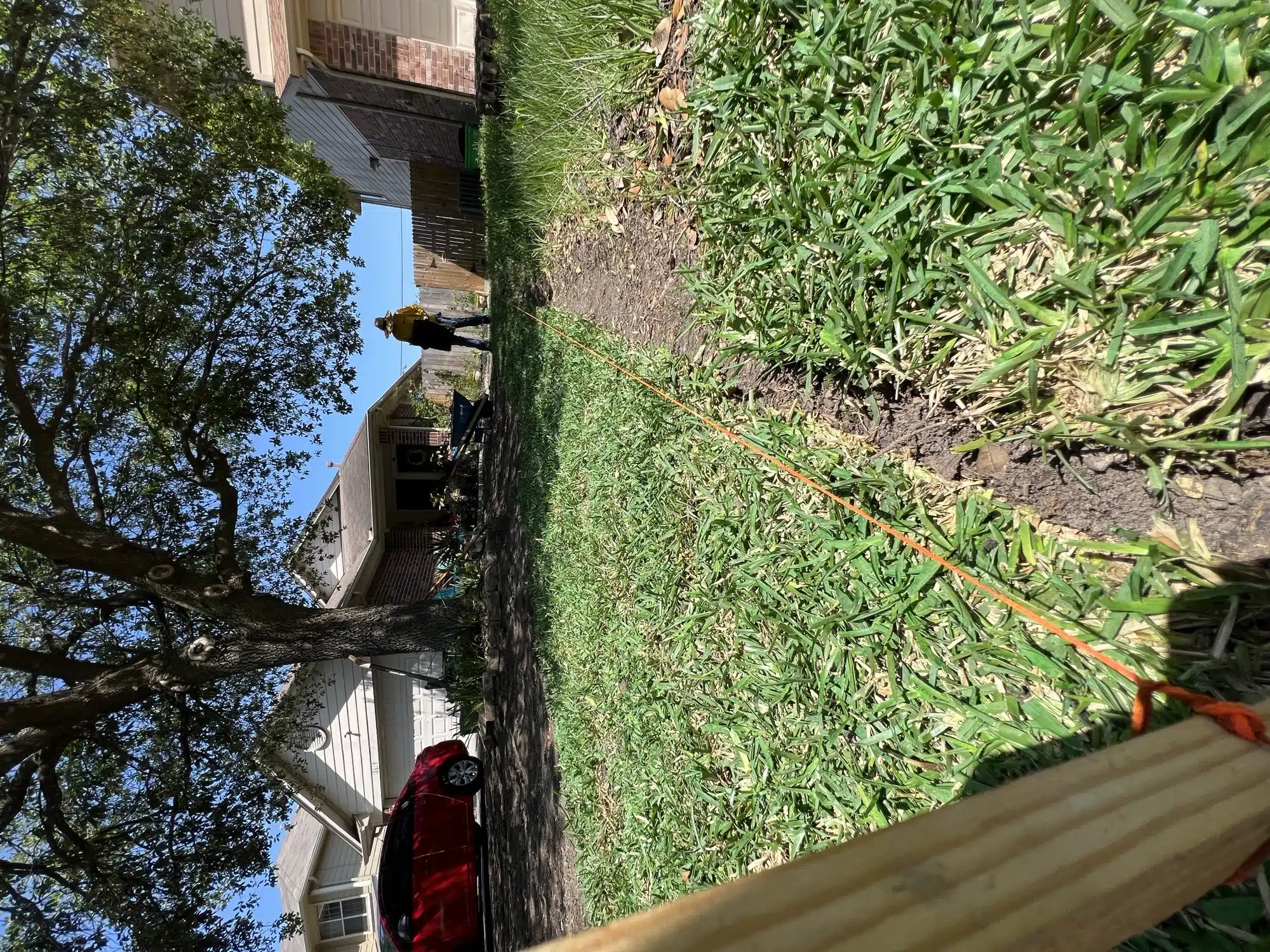 A front lawn sod installation in progress. The prep work before this stage is what helps reduce failure risks later.
This is the most valuable thing I can tell you: a professional diagnosis is optional, but it is highly recommended for larger sod projects or problem areas. We can’t control Mother Nature, but we can reduce uncertainty by identifying obvious risks before the work begins. If you skip this step, you're not just installing a new lawn—you’re taking on unnecessary risk with your investment.
Everything in this guide is here to help you make better decisions and avoid costly mistakes. Our goal is always to educate first, because an informed homeowner makes better long-term choices for their property.
At the same time, every yard in Houston is different. Two lawns on the same street can fail for completely different reasons—drainage, soil composition, shade, or even past treatments. That’s where a general guide reaches its limit, and where a real evaluation becomes valuable.
If you’re planning a larger investment or want a clear, property-specific plan before moving forward, a professional evaluation gives you that second layer of clarity. It allows us to look at your specific property, identify the real cause of failure, and outline the right approach before any work begins.
We still offer straightforward estimates for homeowners who already know what they want. But when the goal is to get it right the first time, especially on full sod installs or repeat problem areas, an evaluation helps avoid repeating the same issue.
If you want to better understand the difference between a basic quote and a full evaluation, this guide on lawn estimate vs evaluation in Houston breaks it down in detail.
At the end of the day, the goal is simple: make sure your investment actually lasts.
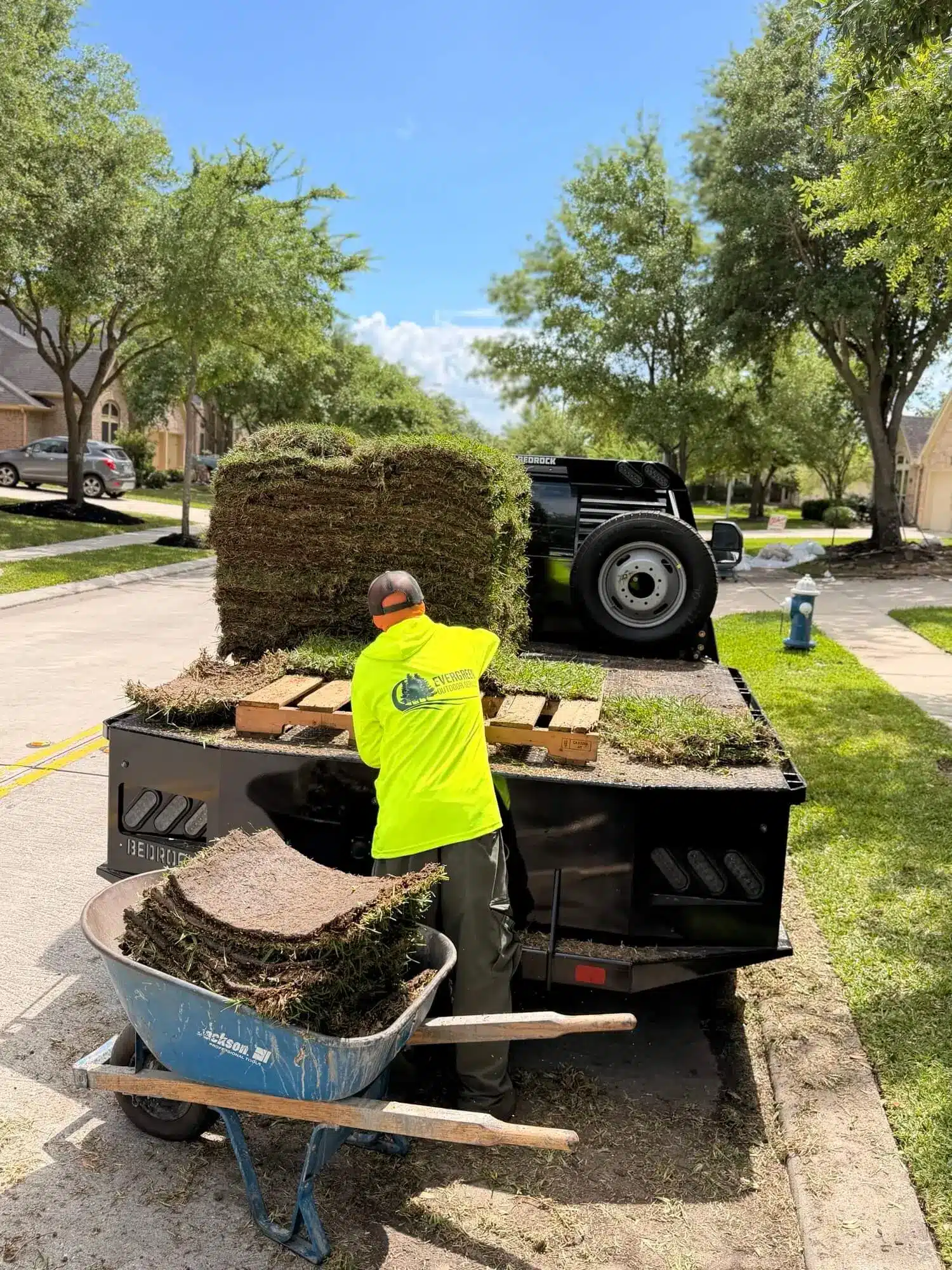 Fresh sod pallets arriving on site. Before this moment, the diagnosis and soil prep work should already be done—not started.
Think of new sod as a skin graft. For a graft to take, it needs 100% contact with the underlying tissue. In landscaping, we call this root-to-soil contact. If the ground is uneven—common in neighborhoods like The Heights where lots are tight and old fill dirt creates strange contours—the sod roll will "bridge" over small dips instead of conforming to them.
That bridge creates an air pocket. In 90% Houston humidity, those pockets act like miniature convection ovens. The roots dangling in that void dry out instantly, even if you're watering the top of the grass. The sod dies from the bottom up while the surface still looks green. By the time you see the brown blades, the root system is already gone. This is why topdressing before laying sod matters—it eliminates those dips so the air gap never forms.
I see this all the time in Sugar Land and Katy. A crew scrapes the old weeds away and drops new sod directly onto the existing clay. No tilling. No amendment. Nothing. This is like trying to grow grass on a concrete sidewalk.
During the August Burn, Houston clay hardens into a hydrophobic brick. New sod roots are only about an inch deep when they arrive. They hit that clay wall and stop—they cannot push through. During an afternoon thunderstorm, water sits on top of the clay and rots the roots from below. During peak heat hours, the clay's surface tension pulls moisture away from the sod instead of releasing it. You get drought stress and root rot at the same time, sometimes in the same week.
The fix is breaking that clay surface before the first roll goes down. We highly recommend aeration before every sod install—it opens the soil without the kind of aggressive disruption that turns a healthy topsoil layer upside down. Here's the thing about tilling: the top few inches of your yard contain the living microorganism layer that actually supports grass growth. If you till aggressively when it isn't necessary—say, the soil isn't compacted but just slightly hard—you're disturbing biology that took years to establish. We'd rather aerate, then amend well.
After aeration, we apply a balanced soil amendment mix specifically formulated for Houston conditions: a combination of screened sand, quality topsoil, compost, and a small amount of finely ground carbon-based mulch that feeds the microbial activity in the root zone long-term. The sticky feel of Black Gumbo on a shovel is your signal—if you can ball it up in your hand like clay pottery, that soil needs help before sod ever touches it.
The April Deluge is the second-biggest killer of new lawns in Houston. If your yard doesn't drain properly—no functional slope, no drainage system—your new sod is literally drowning after every storm. Grass roots need oxygen to survive. When they sit in standing water for more than 24 hours, damping off occurs: a fungal rot that turns the base of the grass mushy and black. You'll smell it before you see it.
If you have pooling water, a drainage solution is your first project—not sod. Installing new grass over a drainage problem is just an expensive way to hide a swamp for a few months. If a drain isn't clear by May, you may have a pond by June. That's not an exaggeration. That's Houston.
Growing grass from seed is like raising a newborn. High maintenance, unforgiving, and full of small windows you cannot miss. You are managing germination timing, soil moisture, washout, bird pressure, and foot traffic before you have anything close to a lawn.
There is another piece most Houston homeowners do not realize. St. Augustine, one of the most common grass types in our area, is not practical to grow from seed. It spreads through sod, plugs, and runners. So if you are trying to seed a St. Augustine lawn to save money, you are not just taking the harder path. You are taking a path that usually does not work.
Starting with sod is more like starting with a teenager. It already has structure, density, and root mass. You do not have to baby it the same way, but you still have to give it the right start. When comparing sod vs seed pros and cons, this is where sod has the clear advantage: faster curb appeal and an established layer of grass from day one.
But sod is not foolproof. One of the most common questions homeowners ask is why does new sod turn brown after laying, and in Houston, the answer usually comes down to poor soil contact, compacted clay, heat stress, drainage issues, or inconsistent watering. That is why knowing what to do before installing new sod matters just as much as knowing when should you water sod after installation.
For the first 14 days, the goal is steady moisture in the soil underneath the sod. Not a quick surface sprinkle. Not a swamp. Damp and spongy is the target.
In Houston heat, that usually means watering early in the morning and again before the hottest part of the afternoon. The exact timing depends on sprinkler output, shade, drainage, wind, and soil conditions. The goal is not just to wet the blades. The goal is to keep moisture reaching the soil underneath the roll.
Here is a quick field check: lift a corner of the sod and look at the soil underneath. If it is muddy and waterlogged, you are overwatering. Back off. If it is dry, dusty, or barely damp, you are underwatering. Add water. What you want is moist soil with enough oxygen for roots to grow.
After day 14, begin transitioning to deeper, less frequent watering. So how long does it take for sod to root? In many Houston lawns, you may see the sod begin grabbing within the first couple of weeks, but full establishment depends on watering, soil preparation, weather, shade, and soil contact. The goal after the first two weeks is to encourage roots to chase water deeper into the soil, which helps the lawn handle Houston heat better.
New grass starts looking shaggy around week two. The instinct is to mow it. Don't.
A new lawn needs time to anchor. If you mow too early, the mower's suction will physically lift the sod rolls off the ground, snapping the delicate root hairs that were just starting to explore the soil below. You're ripping out the very thing you've been trying to build for two weeks.
Wait at least 14 to 21 days. Then tug gently on a corner of a roll. If it lifts, wait longer. When it holds, you're ready—and even then, keep the blade high. Cutting more than one-third of the blade off a new lawn will starve the roots of photosynthetic energy right when they need it most. Our Houston mowing standards are built around this: the blade height is never a cosmetic decision. It's a root health decision.
 Proper roll placement and seam staggering during installation prevents both the Air Gap Trap and edge drying—two of the most common causes of early sod failure.
Getting through establishment is the hard part. But once you're past that first month, the work shifts from survival to maintenance—and the good news is that a well-established Houston lawn is genuinely resilient when you stick to the fundamentals.
Here is what we tell our customers after the sod anchors:
The pattern is simple: feed it, cut it right, don't ignore it in the off-season, and give the soil a reset every couple of years. That's not a complicated program. It's just consistency applied correctly.
| Sod Type | Heat Tolerance | Shade Tolerance | Recovery Speed | Drainage Sensitivity | Establishment Difficulty |
|---|---|---|---|---|---|
| St. Augustine — Palmetto | High | Very High | Moderate | Low | Low — Most forgiving variety in Houston. Handles partial shade and clay well. Best starting point for most homeowners. |
| St. Augustine — Raleigh | Moderate-High | High | Moderate | Low | Low — Cold-hardier than Palmetto. Good choice for north Houston properties or yards with more winter exposure. Slightly coarser blade texture. |
| Bermuda — Tifway 419 | Extreme | Very Low | Very Fast | Low | Medium — Fastest recovery of any Houston sod. Requires full sun all day. Goes dormant brown in winter. Terrible choice for shaded yards. |
| Bermuda — Celebration | Extreme | Low-Moderate | Fast | Low | Medium — Improved drought resistance over Tifway. Slightly better shade tolerance. Still needs strong sun to perform. Fine-bladed and dense when healthy. |
| Zoysia — Palisades | High | Moderate | Slow | Medium-High | High — Attractive, dense turf but slow to establish. Drainage and pH must be addressed before install or it will thin out and stall. |
| Zoysia — Zeon | High | Moderate-High | Very Slow | High | Very High — Fine-bladed luxury variety. Slowest establishment of any common Houston sod. Soil prep and drainage must be close to perfect. Not a DIY-friendly install. |
| Zoysia — Emerald | Moderate-High | Moderate | Very Slow | High | Very High — Extremely fine texture, almost carpet-like. High maintenance demand. Less heat-tolerant than Palisades in full Houston summer exposure. Best in managed, irrigated settings. |
For most Houston homeowners, St. Augustine Palmetto remains the most forgiving starting point—it handles partial shade, clay soil, and Houston's inconsistent weather better than most alternatives. Raleigh is worth considering if you're in a cooler or more exposed northern part of the metro. The Bermuda varieties are built for full-sun, high-traffic situations and recover fast, but they go brown in winter and fail completely in shade. The Zoysia options are premium-looking turf that demands premium prep—especially on drainage. If you want Zoysia's look, you have to earn it with the right groundwork first. Grass choice also affects budget, so if you're comparing varieties and trying to understand what changes the final price, our sod installation cost guide for Houston breaks down how grass type, prep, and site conditions move the numbers. For a full breakdown of how each variety performs here, see our Zoysia care guide and the Houston grass types overview.
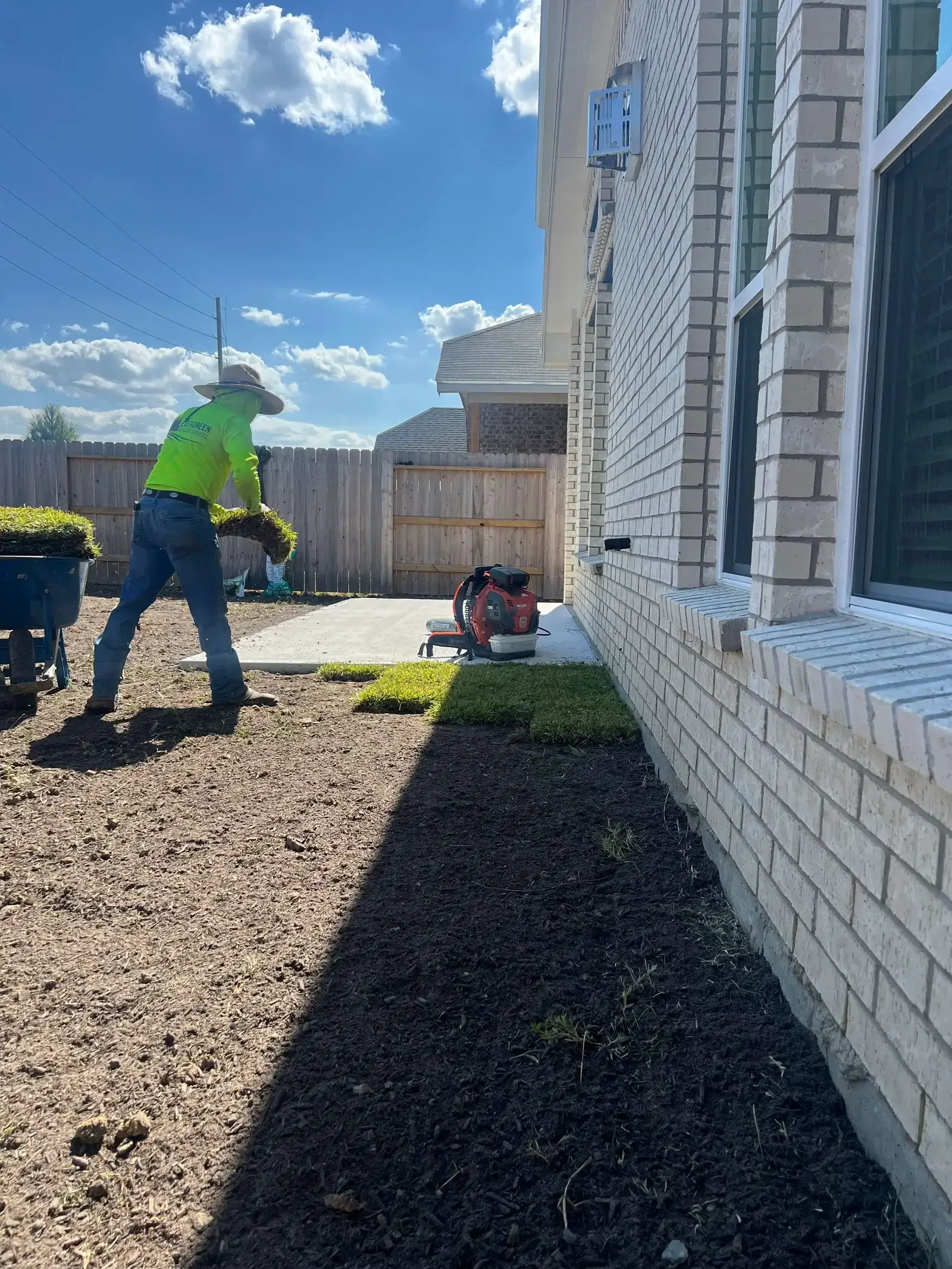 Sod near concrete and hardscape areas needs careful grading, watering, and soil prep because heat and runoff can create extra stress.
In The Heights and Montrose, the biggest risk is shade failure. Homeowners install Zoysia because it's a premium variety, but the narrow gaps between houses and the massive Live Oaks overhead don't provide the consistent sun hours it needs. The grass thins by the end of the first summer, and by year two it's mostly bare soil with scattered blades. It's not the grass's fault—it's a mismatch between variety and micro-environment.
In Cypress, Katy, and Sugar Land, the issue is often open exposure. Large lots with little natural wind resistance—no mature trees, no fence lines, minimal structure—dry out faster than you'd expect, especially when new sod is getting cut too short in the middle of summer. The sun beats straight down on the root zone with nowhere to hide, and any moisture that's there evaporates fast. It's a double whammy: the grass is already stressed from mowing too low, and the wind conditions are working against it both at once. In these areas, we prioritize a heavier soil prep that holds moisture at the root level, and if we maintain the sod afterward, we're strict about blade height during the first few months especially.
In The Woodlands and Kingwood, the challenge shifts to pine needle acidity and moisture buildup in low areas. The soil pH can drift lower than the rest of Houston, the debris can smother the grass blades and drainage issues hide under the canopy where you can't always see standing water until after a major rain event. If you're in a treed lot in these areas, a soil test and a drainage consultation are both highly recommended before sodding. This is part of why our landscape maintenance approach is always matched to the specific property conditions, not a one-size formula.
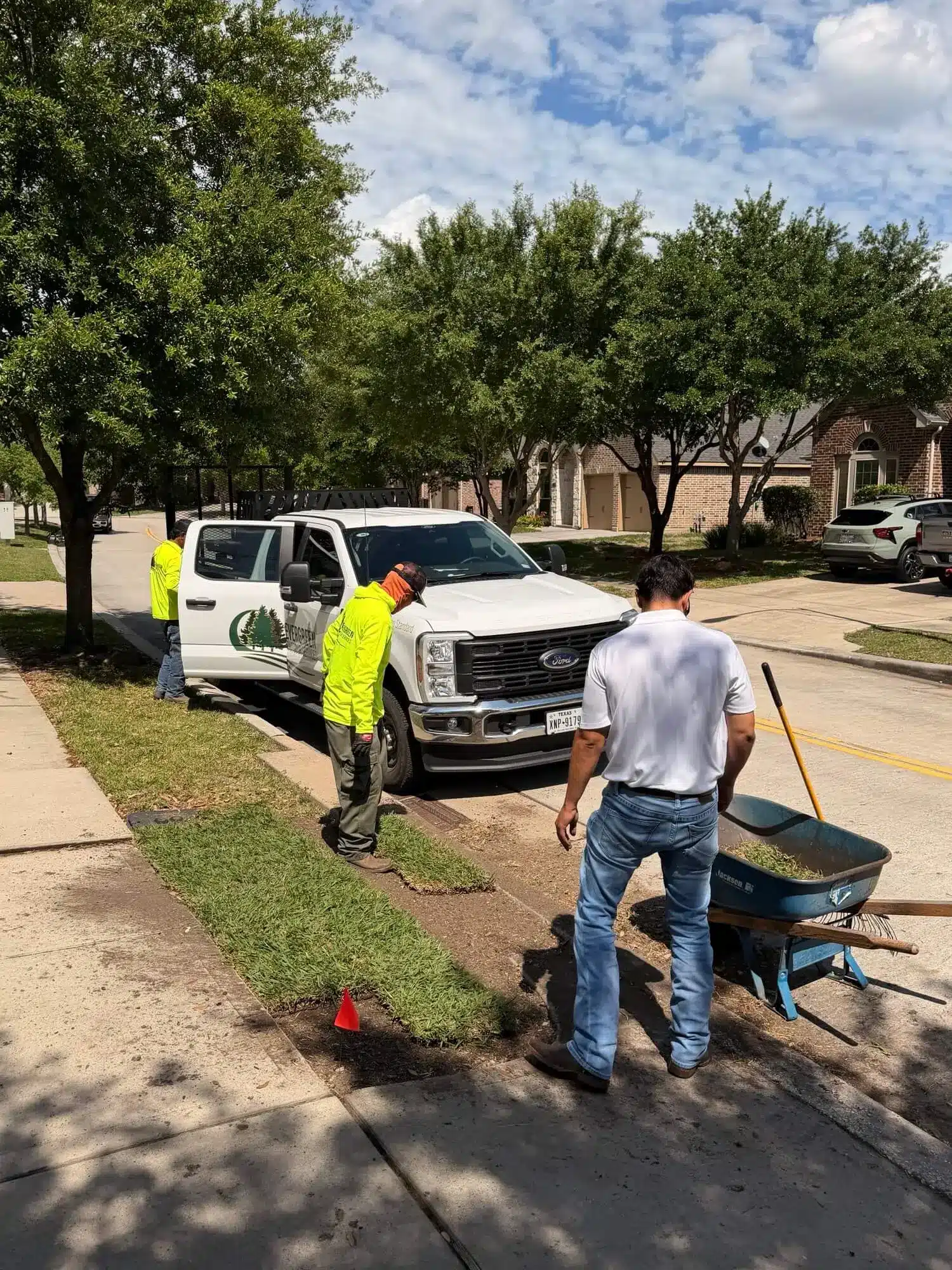 A front lawn sod installation in Houston. The work that happens before this moment—the diagnosis, the soil prep, the drainage check—is what determines whether this lawn is still thriving six months later.
This is something we explain to every customer upfront, especially when we’re re-sodding a lawn that previously had significant weed coverage. Even with proper removal and soil preparation, some weeds may appear as the new sod establishes. That does not automatically mean the installation failed or that the sod arrived contaminated.
Houston soil can hold dormant weed seeds, roots, and plant fragments from previous seasons. Preparing the area disturbs the soil, and the combination of sunlight, warmth, and frequent watering can encourage some of that existing weed pressure to reappear. Newly installed sod also needs time to root, spread, and form the dense turf canopy that naturally limits future weed growth.
The priority during establishment is helping the sod develop strong roots. Follow the recommended watering schedule, avoid mowing too low, and use fertilization appropriate for the grass type, season, and property conditions. A healthy, properly maintained lawn gradually shades the soil and competes more effectively against emerging weeds.
Small, isolated weeds can often be removed by hand before they mature and produce seed. Avoid aggressive pulling that could lift sod that has not fully rooted. Herbicides should not be applied automatically to newly installed turf, since product suitability and timing depend on the grass variety, weed type, and stage of establishment.
For additional seasonal guidance, review our Houston seasonal weed control guide.
We’re grateful to every client who trusts Evergreen with a new lawn. After installing and repairing sod across Greater Houston, we’ve seen that the best results come from honest expectations, careful preparation, and consistent care during establishment. Our goal is to help each client understand what the lawn needs so it has the strongest chance to root well, fill in, and stay healthy over time.
New sod can look good at first and still fail if the real issue is underneath it. Common causes include poor drainage, compacted clay, weak soil contact, too much shade, or watering mistakes during establishment. If drainage is part of the problem, understanding the difference between a French drain and a surface drain can help you avoid covering the same issue with new grass.
For small sod repairs, a basic estimate may be enough. For larger sod projects, repeat problem areas, or lawns that have already failed once, a professional evaluation is highly recommended. It helps identify the cause before new sod is installed. This guide on lawn estimate vs evaluation in Houston explains the difference without turning the sod project into guesswork.
During the first two weeks, the goal is steady moisture under the sod, not just wet grass blades. Most lawns need watering early and again before the hottest part of the afternoon, but timing depends on sun, shade, soil, drainage, and sprinkler output. Houston heat stress can move fast, so watch the lawn closely during establishment and adjust based on what the soil under the sod is doing.
Grey-green color and curling blades usually mean drought stress or poor root contact. It may be caused by missed watering, an irrigation blind spot, an air gap under the sod, or compacted soil stopping roots from reaching moisture. Check the soil underneath right away. If it is dry, water deeply by hand and make sure the sod is firmly touching the soil.
Usually, no. New sod often arrives with enough nutrients to get through the early establishment stage. Fertilizing too soon can stress tender roots. Once the sod is anchored, a steady slow-release fertilization program can support density, color, and long-term turf health.
Yes. Even clean sod can show weeds after installation because Houston soil often contains dormant weed seeds. Soil prep can bring those seeds closer to the surface where light and moisture trigger growth. The goal is to establish thick turf first, then manage weeds with proper mowing, watering, feeding, and a seasonal weed-control plan when appropriate.
Yes, when the site conditions are right. For small businesses, offices, retail centers, and rental properties, healthy turf can make the property feel cleaner and more welcoming. But if the lawn failed because of drainage, shade, or poor soil, sod alone may not hold up. This is where a proper evaluation protects both curb appeal and the property investment.
If you are considering a new lawn, sod replacement, or sod repair in Greater Houston, Evergreen Outdoor Services can help you understand the preparation involved, identify important site conditions, and provide a clear project estimate.
Straightforward sod repairs may only require a complimentary estimate. For larger sod installations, repeat problem areas, drainage concerns, irrigation issues, or lawns that have failed before, we may recommend a more detailed lawn evaluation before finalizing the scope. This helps reduce guesswork and protect your investment in the new grass.
Every property is different, but our commitment remains the same: honest recommendations, proper soil preparation, clear communication, professional sod installation, and practical establishment guidance designed to give the new lawn the strongest opportunity to root and perform well.