Sod installation in Houston generally runs $2 to $4.50 per square foot installed, with most residential projects landing between $3,500 and $9,500 total. That range is wide because sod pricing isn't just about grass—it's about what your specific yard actually needs before the first roll goes down. Soil prep, drainage corrections, grass variety, and lot access all move the number. Use per-square-foot as a ballpark, not a budget. A good contractor doesn't just multiply square footage—they look at the whole picture and work with you to find the right fit for your yard and your wallet.
The sod itself is rarely the expensive part. Site prep is where most homeowners either protect their investment or guarantee a second install.

Here is where most people mess up: they price the grass and forget to price the yard. A pallet of St. Augustine costs what it costs at the supplier. What varies wildly from job to job is everything that happens before and during the install.
Four things move the number most:
The grass variety decision is the biggest controllable cost lever. Here's what the market actually looks like in Houston for 2026. Keep in mind: per square foot is a useful estimate, not a quote. A good contractor looks at the whole picture—your yard's shape, access, soil condition, drainage, and your budget—and works with you to find the right fit. Numbers below are ranges, not invoices.
Also worth noting: real-world pallet coverage is closer to ~425 sq ft after accounting for cuts and waste on a standard rectangular yard—and even less on irregular or broken-up shapes. Budget a little extra on pallets for anything but a clean rectangle.
| Variety | Sod Cost (Per Pallet) | Installed Cost (Per Sq Ft) | Coverage Per Pallet | Houston Fit |
|---|---|---|---|---|
| St. Augustine — Palmetto | $250–$450 delivered* | $2.25–$2.75 | ~425 sq ft† | Best all-around. Shade, clay, humidity. Most forgiving. Min job: ~$650. |
| St. Augustine — Raleigh | $250–$450 delivered* | $2.25–$2.85 | ~425 sq ft† | Slightly cold-hardier. Good for north Houston and Woodlands lots. Min job: ~$650. |
| Bermuda — Tifway 419 | $280–$500 delivered* | $2.35–$2.85 | ~425 sq ft† | Full sun only. Fastest recovery. Goes brown in winter. Min job: ~$650. |
| Bermuda — Celebration | $280–$500 delivered* | $2.40–$2.95 | ~425 sq ft† | Marginally better shade tolerance than 419. Dense and fine-bladed. Min job: ~$650. |
| Zoysia — Palisades | $400–$700 delivered* | $2.75–$3.50 | ~425 sq ft† | Premium turf, slow to establish. Harder to source—often requires advance ordering. Min job: ~$1,000. |
| Zoysia — Zeon | $450–$750 delivered* | $3.25–$4.00 | ~425 sq ft† | Fine-bladed luxury. Limited local sourcing—may require special order and longer lead times. Min job: ~$1,000. |
| Zoysia — Emerald | $500–$800 delivered* | $3.25–$4.25 | ~425 sq ft† | Carpet-like texture. Hardest to source in Houston—expect lead time and logistics premium. Min job: ~$1,000. |
* Delivered cost per pallet includes sod price, delivery fee, fuel surcharge, and logistics coordination. DIY buyers who pick up themselves still pay fuel, trailer rental, and time—costs that often rival delivery fees. Zoysia varieties may carry additional sourcing or special-order premiums depending on availability. · † ~425 sq ft is real-world coverage after accounting for cuts and edge waste on a standard yard. Irregular or broken-up shapes may yield less—budget an extra pallet if your layout has angles, curves, or obstacles.
For a full breakdown of how each variety performs in Houston's climate, see the Houston grass types overview. If you're weighing Zoysia specifically, the Zoysia care guide covers what proper establishment actually costs in time, prep, and ongoing care.
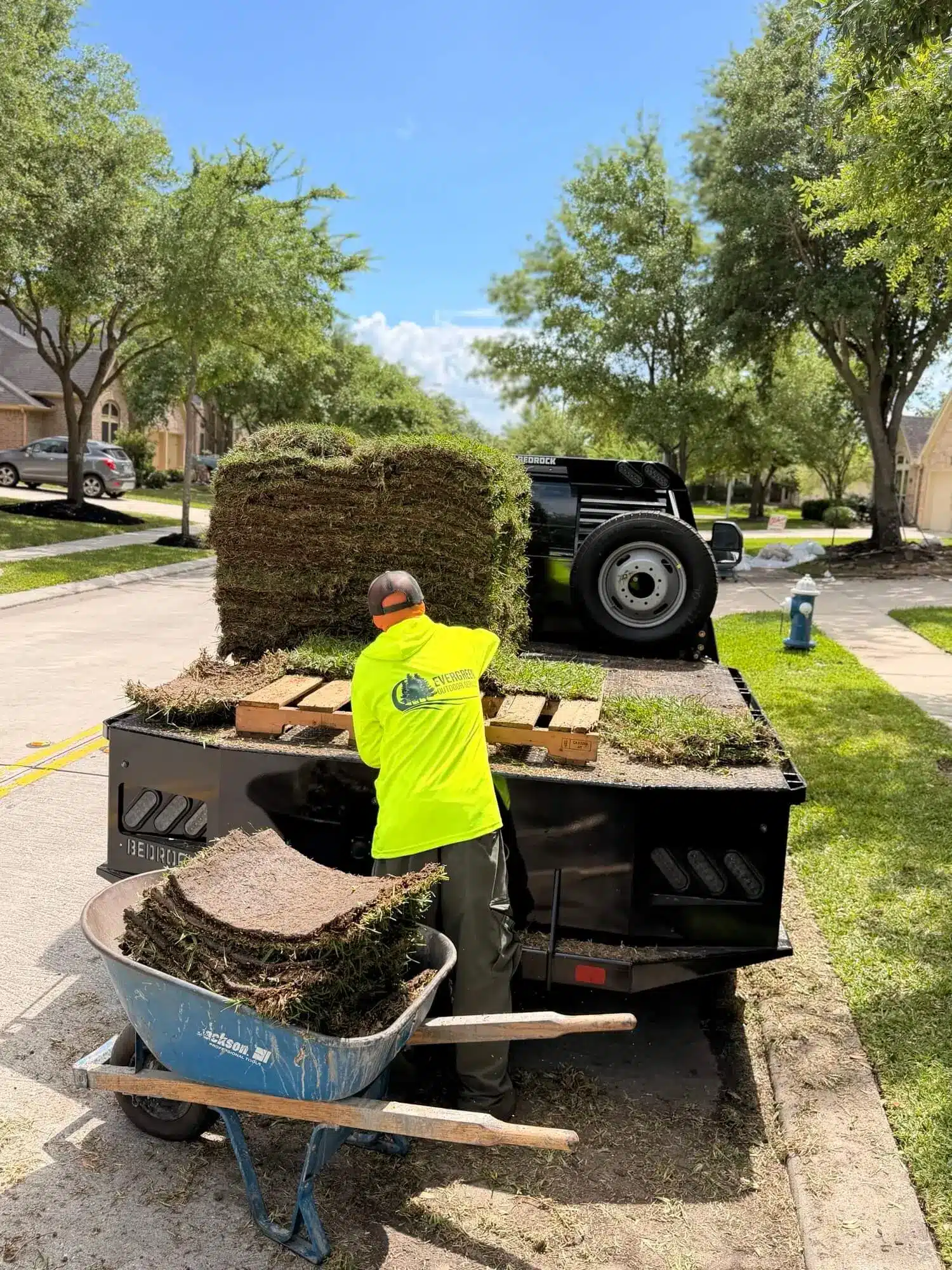 Pallets staged and ready for a Houston install. The variety on those pallets, and the prep work done before they arrived, is what determines whether this is a one-time investment or a recurring expense.
Look, the reality is this: most failed sod installs in Houston aren't a grass problem. They're a prep problem. And prep is the cost line that homeowners most often try to cut—which is exactly backwards.
Here's what site prep actually costs and what each item does:
The full picture of what can kill a new install—and how to identify it before you spend anything—is in the Houston sod failure guide. Read that before you finalize a budget.
The math here is straightforward but consistently surprises homeowners. Smaller jobs cost more per square foot because the fixed costs—delivery, mobilization, equipment, minimum labor charges—don't shrink with the square footage.
| Project Size | Estimated Total (St. Augustine) | Estimated Total (Zoysia) | Notes |
|---|---|---|---|
| 250–500 sq ft (patch repair) | $900–$1,600 | $1,200–$2,000 | Minimum job pricing applies. Higher per-foot cost. |
| 500–1,000 sq ft (small yard) | $1,400–$2,800 | $2,000–$3,500 | Fixed costs begin to spread. More competitive pricing. |
| 1,000–2,500 sq ft (average yard) | $2,800–$6,500 | $3,500–$8,500 | Most Houston residential installs fall here. Per-sq-ft varies by variety, prep, and site conditions. |
| 2,500–5,000 sq ft (large yard) | $6,000–$13,000 | $8,000–$17,000+ | Site prep costs become proportionally larger at this scale. |
| 5,000+ sq ft (acreage / commercial) | Custom quote | Custom quote | Volume pricing available. Site assessment required. |
These ranges assume basic site conditions. Any drainage work, significant grading, or soil remediation adds to the totals above. Use the material estimator tool to calculate your square footage and rough pallet count before getting quotes.
The False Spring window—late February through April—is the highest-success period for sod installation in Houston. Soil temperatures are warm enough to support root development, the August Burn hasn't arrived, and irrigation demands are manageable. This is also when most installers are in high demand, so getting on the schedule early matters.
Fall is the second-best window. Once the relentless heat of summer breaks—usually September into October—soil temperatures drop into the range that supports establishment without the punishing evaporation rate of peak summer. A fall install gives the grass a full cool season to anchor before it needs to perform through a Houston summer.
Summer installs in Houston are absolutely possible, but they require a higher level of attention and discipline. You’re working through extreme heat, so irrigation timing, coverage, and consistency become critical during the establishment period. Even small gaps in watering or unnoticed drainage issues can show up quickly under summer stress.
That doesn’t mean you have to wait. It simply means the approach needs to adjust. With the right preparation, proper irrigation planning, and close monitoring during the first few weeks, sod can be successfully installed year-round in Houston—including summer and winter.
The goal is not to avoid installation—it’s to understand the conditions and adapt the plan so your investment has the best chance to establish and hold up over time.
Houston isn't one yard. The conditions vary dramatically by area, and so does what a proper install actually costs.
The Heights and Montrose: Tight lots, zero lot lines, narrow gates, and alley drainage issues. Getting equipment and pallets to the backyard often requires more labor time than a comparable open-lot job in Katy. Access fees or manual labor premiums are common on small urban lots. The upside is that shade-tolerant St. Augustine Palmetto tends to perform well in these neighborhoods.
Cypress, Katy, and Sugar Land: Open lots mean better access, but Black Gumbo clay is at its worst here. Ground cracking in August is a real visual—and structural—indicator of how badly the clay behaves without a root system holding moisture at the surface. Soil prep costs are higher here because the amendment need is greater. Grading issues from settling lots are also common on newer developments.
The Woodlands and Kingwood: Pine needle acidity shifts the soil pH in ways that affect St. Augustine and Zoysia differently. A soil test is not optional here—it's a pre-install requirement. Drainage in treed lots also hides until you get a real rain event. If a drain isn't clear by May, you may have a pond by June. Factor that in before you quote the sod alone.
Memorial and River Oaks: Massive oak canopies mean serious shade management. Bermuda will fail here. Even some Zoysia varieties struggle. Palmetto St. Augustine is usually the right call, and the established-tree root systems can complicate soil prep depth. Expect higher site prep costs on older lots with extensive surface root systems.
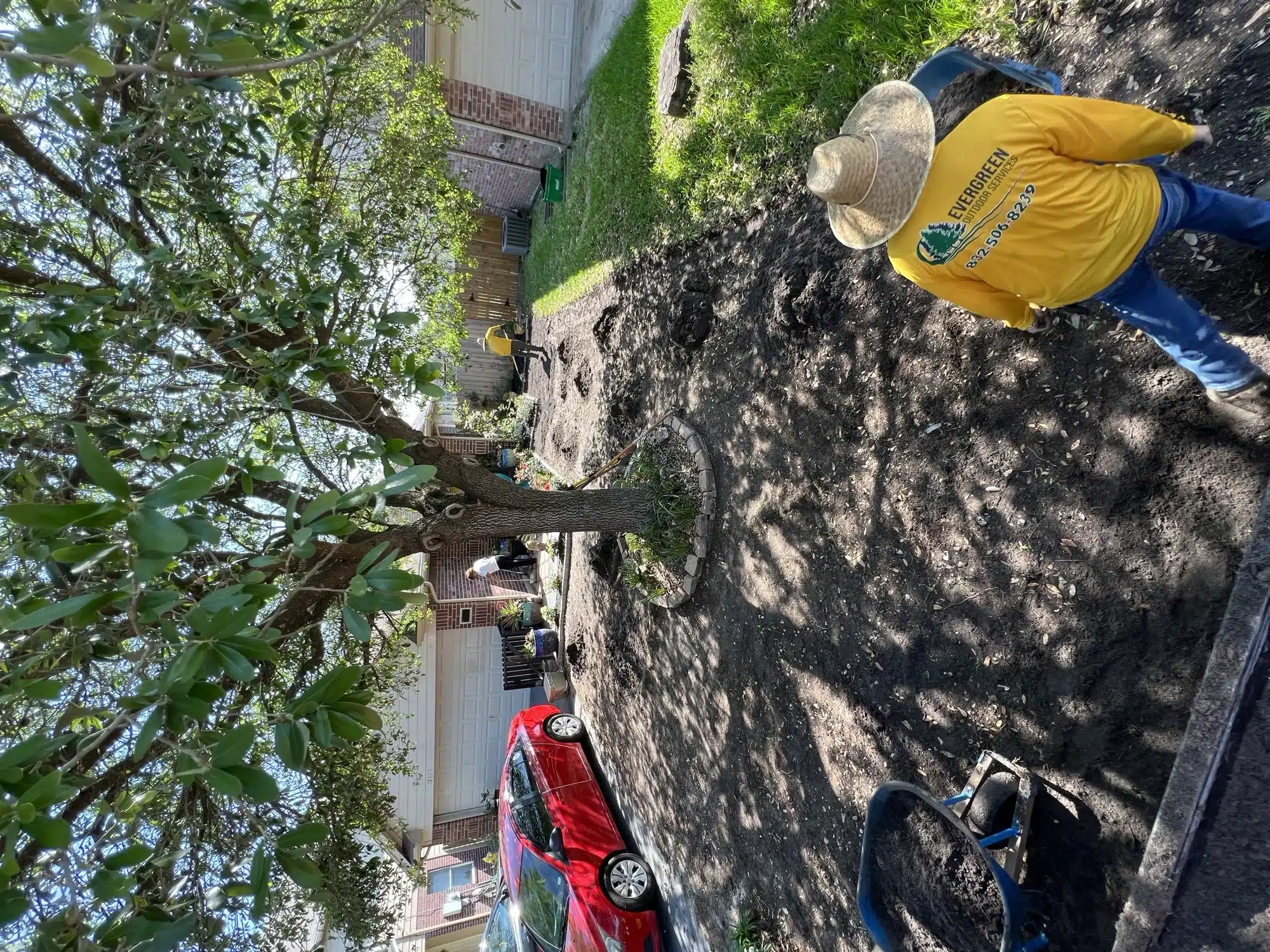 A properly installed and established front lawn. The prep work, variety selection, and timing decisions that led to this moment are what made it last.
DIY sod installation can save money, especially on smaller, straightforward areas. But the savings are usually smaller than homeowners expect once delivery, tools, soil materials, disposal, time, and realistic project hiccups are included.
Here is a realistic cost breakdown for a 1,500 sq ft DIY St. Augustine install:
Time and hassle also have a real cost. A professional crew that installs sod day in and day out in Houston has the workers, equipment, rhythm, and experience to move efficiently. A DIY homeowner usually does not move at that same pace, especially when handling prep, logistics, and cleanup for the first time.
Once you include pickup or delivery coordination, unloading nearly 4 pallets of sod, old turf removal, soil prep, grading, laying sod, cleanup, watering setup, and fixing small mistakes along the way, the time commitment adds up quickly. For many homeowners, a 1,500 sq ft DIY sod install can turn into multiple long days of work. If you put even a modest value on your time, that “savings” can shrink fast.
Real-world examples we’ve seen:
These are not guaranteed outcomes, but they are common enough in Houston conditions that they are worth planning for upfront.
A professional install for the same 1,500 sq ft area with basic prep often lands around $3,800–$5,000, depending on access, soil conditions, grass type, and the amount of preparation needed. That gap is real. DIY may make sense when the area is very small, flat, easy to access, and already in good condition.
The main risk is not the physical labor. It is missing something important before the sod goes down. If there is a drainage issue, pH problem, compaction layer, shade mismatch, or irrigation blind spot, the lawn can struggle no matter how hard you worked.
That is why the real question is not just “Can I install sod myself?” It is “Do I understand the site well enough to protect the investment—and is this really the best use of my limited time?” For busy homeowners, professionals, and property owners, hauling sod, soil, sand, and equipment through Houston heat is rarely the highest-value use of your time. If you still want to take the DIY route, our Houston sodding guide walks through what proper prep looks like so you can approach the project with a better plan.
Professional sod installation in Houston commonly ranges from about $2.00 to $4.50+ per square foot installed, depending on grass type, prep work, access, drainage, and soil conditions. Many residential projects land somewhere around $3,500 to $9,500, but every yard is different. A real quote should account for your specific lawn, not just the price of sod by the pallet.
Site preparation is usually the biggest cost variable. Drainage problems, compacted clay, low spots, old turf removal, grading, and soil amendment work can all increase the scope before sod is installed. Skipping prep may lower the upfront price, but it can increase the risk of the lawn struggling later. Our guide on why new sod fails in Houston explains why the prep stage matters so much.
Yes, in most cases. Zoysia usually costs more than St. Augustine because the material is often more expensive and the prep needs to be more precise. It can be a beautiful premium turf, but it is slower to establish and less forgiving of poor drainage or weak soil prep. Our Houston Zoysia grass guide breaks down what to consider before choosing it.
Yes. Smaller sod repairs often cost more per square foot because mobilization, delivery, labor, and setup time are spread across less area. Larger projects may have a lower per-square-foot rate when the access is good and the work is efficient, but total cost still depends on prep, grass type, drainage, and site conditions.
Sod can be installed year-round in Houston, but the plan has to match the season. Spring and fall are usually easier establishment windows because temperatures are more forgiving. Summer installs are possible, but watering coverage and timing become much more important. Winter installs can also work, but rooting may be slower until warmer weather returns.
Yes, especially on small, straightforward areas. The key is being honest about the full cost, including delivery or pickup, soil materials, equipment rental, disposal, time, and mistakes. The biggest DIY risk is missing drainage, grading, soil, or irrigation issues before the sod goes down. If you want to do it yourself, our Houston sodding guide can help you understand the prep work involved.
If this guide made one thing clear, it's that sod pricing is not just a grass quote—it's a site assessment. The cost difference between a lawn that lasts and one that gets replaced is almost always in the prep, not the pallet.
We've done this across Houston long enough to know what each neighborhood's soil, shade, and drainage conditions actually demand—and how to get it right the first time.
If you’re comparing quotes, this guide gives you the framework to understand what you’re really being sold—and what might be missing from the scope.