
Watching your backyard turn into a private lake after a twenty-minute Houston thunderstorm is a gut-punch. In neighborhoods like The Heights and Summerwood, we see this cycle constantly. You stand on the patio watching water creep closer to the back door, wondering whether poor drainage is starting to threaten your foundation, lawn, or outdoor living space. At that point, the question usually comes down to two options: a French drain vs. a surface drain.
The core difference is simple: a surface drain captures standing water quickly from patios, driveways, low spots, and downspouts. A French drain is a buried gravel-and-pipe system designed to relieve saturated soil below the surface. For most Houston yards with heavy Black Gumbo clay, surface drains are usually the first line of defense against active pooling, while French drains are better for drying out mushy soil, wet beds, side yards, and areas near foundation edges.
The reality is, Houston rain often falls faster than our native clay soil can absorb it. A surface drain, also called a catch basin system, is designed to collect standing water quickly from the surface. Think of it like a funnel for your yard. These drains are usually placed in low spots, near patios, beside walkways, or anywhere water naturally collects after heavy rain.
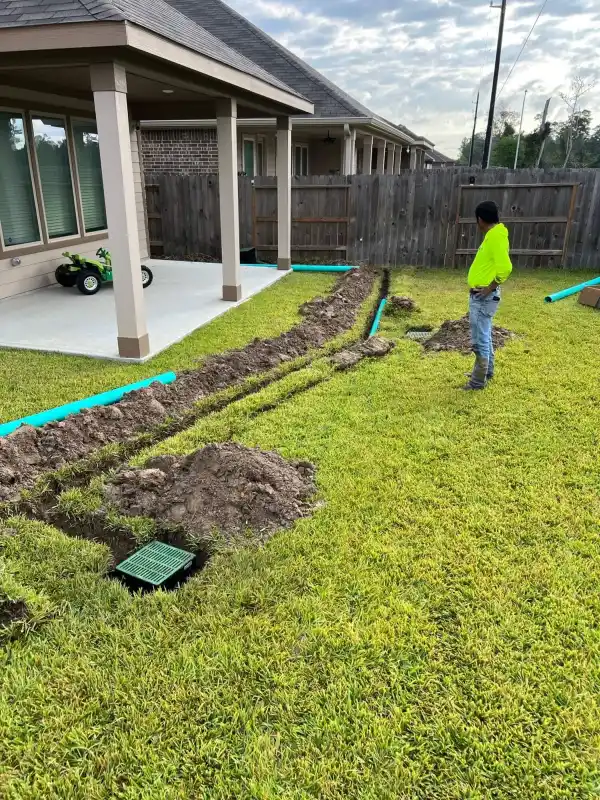 Surface drains are the front-line defense against pooling water that threatens your home's entry points.
The key detail is that a surface drain is only as good as the pipe connected to it. Cheap corrugated pipe can trap silt, mulch, grass clippings, and debris in its ridges, especially during heavy Houston storms. For surface drainage systems, we prefer smooth-wall pipe because it moves water and debris more efficiently toward the discharge point instead of letting it sit inside the line.
Here is where most people get confused: they think a French drain is a catch-all solution for every puddle in the yard. It is not. A French drain is a perforated pipe surrounded by gravel and wrapped in drainage fabric. Its main job is to relieve saturated soil and move excess water away before it sits against your lawn, landscape, or foundation.
Think of it as an underground escape route for water. When Houston’s clay soil becomes saturated, water needs somewhere easier to go. The fabric helps keep soil out, the gravel creates open space for water to move, and the perforated pipe carries that water away to a proper discharge point.
That is why French drains are great for soggy side yards, wet landscape beds, and areas where water lingers below the surface. But if you have a 3-inch deep puddle sitting on top of the lawn after heavy rain, a French drain by itself may work too slowly. In those cases, a surface drain, catch basin, grading correction, or combination system may be the better solution.
To understand why a French drain works, you have to understand the physics of displacement. In Houston, we often see these failing because they were installed in pure clay without enough gravel "room" to breathe. Below is an infographic of what a high-performing system looks like.
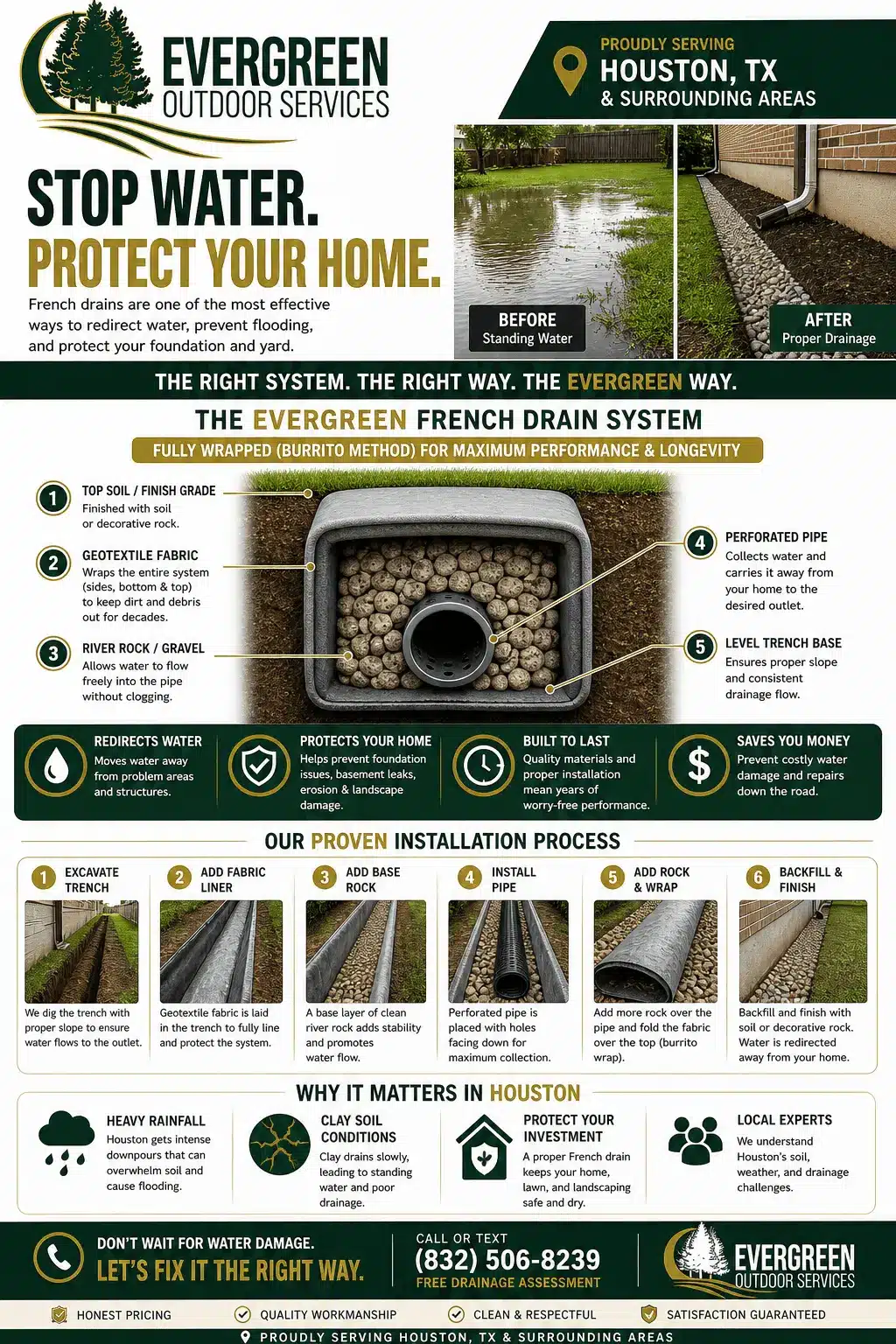 Struggling with standing water? Our fully wrapped French drain system redirects water away from your home and protects your foundation from costly damage.
The secret to a long-lasting French drain in Houston's Black Gumbo is the fabric wrap. Without a high-quality non-woven geotextile fabric, tiny clay particles can infiltrate the gravel and clog the pipe holes over time. This is one of the biggest reasons French drain systems fail in Houston-area clay soils.
We see this often in areas like Kingwood, Bellaire, and throughout the Houston area. Homeowners do not always realize how much pressure wet clay soil can create. When Houston’s Black Gumbo clay gets saturated, it expands. If standing water sits near the house for long periods, that soil movement can slowly push against your foundation, nearby flatwork, and landscape beds over time.
A properly designed drainage system, whether it is a French drain, surface drain, grading correction, or combination system, is not just about removing water. It is about relieving soil pressure and moving water away before it causes bigger and more expensive problems.
Foundation repairs in Houston can become expensive fast, especially when drainage issues are ignored for years. That is why we treat Houston yard drainage solutions as a matter of long-term property protection, not just curb appeal.
In The Heights, with zero lot lines and narrow side yards, your neighbor’s drainage can quickly become your foundation’s problem. There is very little room to manage water, so solutions have to be precise. In these tight layouts, we often design systems that daylight to the curb using a pop-up emitter or controlled discharge point.
Meanwhile, in Memorial, the large oak canopies limit sunlight and slow down evaporation. Even without major rainfall, these yards can stay consistently damp and soft. In these conditions, French drains are extremely effective at pulling excess moisture out of the soil, helping stabilize the ground and allowing for routine services like professional mowing without damaging the lawn.
| Feature | Surface Drain / Catch Basin | French Drain / Subsurface Drain | Evergreen Hybrid System |
|---|---|---|---|
| Primary Goal | Move standing water quickly | Relieve saturated soil | Manage both surface water and soil moisture |
| Intake Method | Grated basin open to surface water | Fabric-wrapped gravel trench with perforated pipe | Multi-point capture with proper discharge |
| Best For | Patios, low spots, driveways, and downspouts | Mushy soil, wet beds, side yards, and foundation edges | Typical Houston yards with both pooling and soggy soil |
| Maintenance | Clean leaves and debris from grates | Inspect outlets and flush when needed | Annual system check after heavy rain seasons |
| Pipe Type | Solid smooth-wall pipe | Perforated drainage pipe | Solid and perforated pipe used where appropriate |
What most homeowners don’t realize is that a drainage installation is a messy, technical surgery. It requires excavating tons of heavy clay and replacing it with specific aggregate. If you've ever tried to dig a trench in a Houston July, you know the "Black Gumbo" doesn't give up easily.
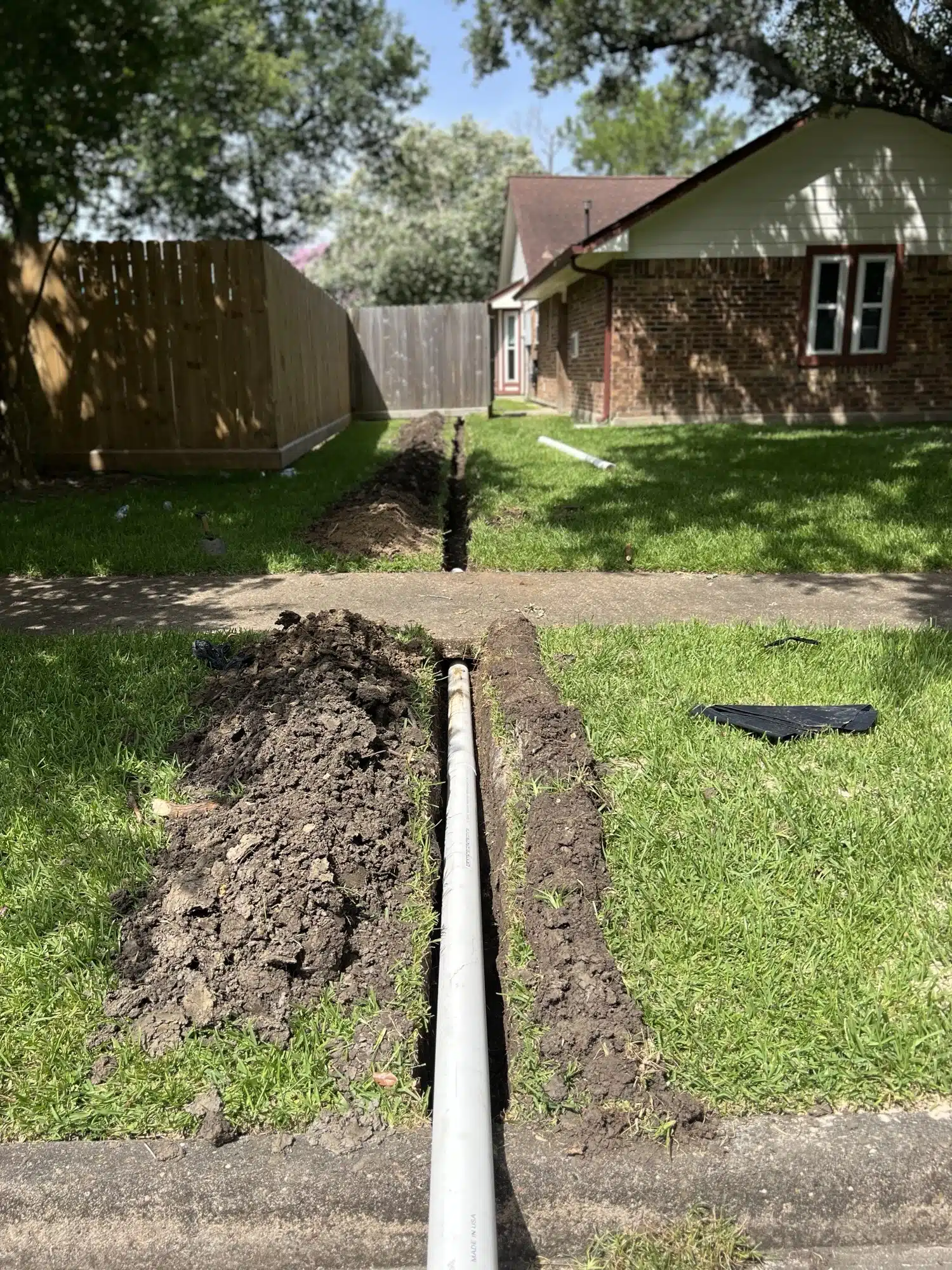 Work in progress: Proper drainage requires deep trenches and precise leveling to ensure the water actually moves.
We use proper leveling tools to ensure that the water is actually "daylighting" at the curb. Without the correct 1% slope (1 foot of drop for every 100 feet of pipe), your drainage pipe is just a very expensive, underground mosquito breeder. If you're unsure about your yard's grade, check our general FAQ for how we measure slopes.
Not necessarily. If the water is pooling on top of the lawn, a surface drain with a catch basin is much faster and more effective. You only need a French drain if the soil stays mushy and soft for days after the visible water is gone.
No. Roof water is too high-volume and contains shingle grit and debris. Tying them into a French drain will overwhelm the pipe and clog the perforations. Downspouts should run into a dedicated, solid-wall pipe that exits at the street.
Schedule 40 PVC or SDR-35. Avoid the black corrugated "flexible" pipe at all costs. It is impossible to clean, easily crushed by our shifting clay, and doesn't maintain a consistent slope.
Usually 12 to 18 inches. In our heavy clay, going deeper often causes the pipe to sit in a "bathtub" of water that never moves. The goal is to stay within the active soil layer.
Yes. Even the best systems need a health check. We recommend flushing the lines with a high-pressure hose once a year to clear out the silt that our Houston rains inevitably carry into the basins.
If you've read this and realized that drainage is more about civil engineering and proper levels than just digging a trench, we're here to help. Professional drainage work helps you avoid costly mistakes, protect your property, and get lasting results done right.
Prefer to talk directly? Call or text us for a drainage assessment.