
Published August 2026 · Evergreen Outdoor Services · Houston, TX
Houston hurricane yard prep starts with the property outside your house, not the pantry. Most hurricane guides cover evacuation routes, emergency water, and sheltering. This guide covers the part we work with every day: your trees, drainage, lawn, and outdoor structures. If a storm is approaching and you are wondering what to actually do outside your house, this checklist walks through it step by step.
We will leave evacuation plans and emergency supplies to emergency-management officials. ReadyHarris and the National Hurricane Center are the right sources for those. What follows is the outdoor-property workflow we use and recommend to Houston homeowners before hurricane season and before individual storms.
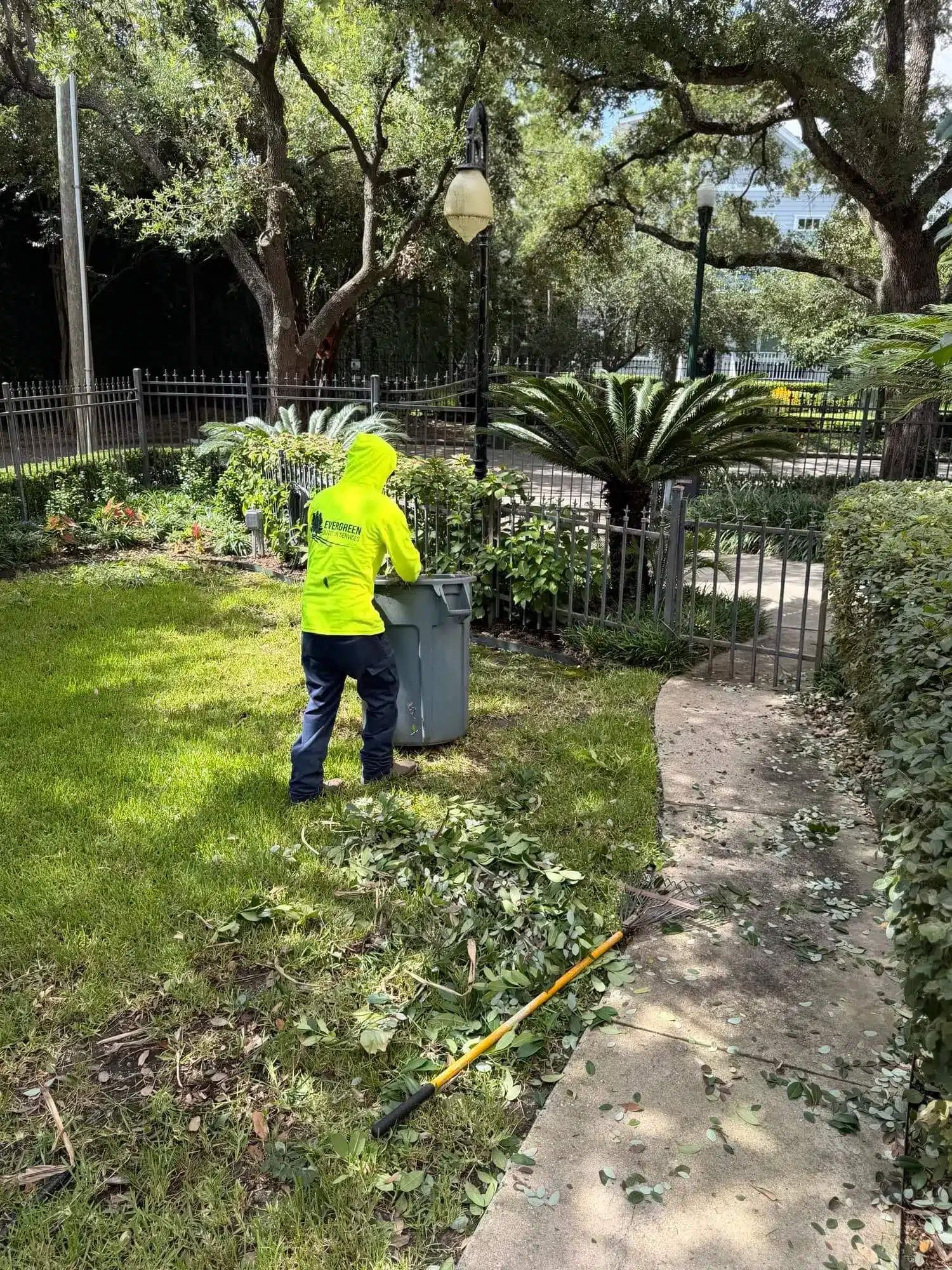 Clearing yard debris and maintaining your landscape before hurricane season reduces windborne hazards and protects your property.
This is an outdoor-property preparation guide. It is not an emergency-management document and does not replace official evacuation orders, shelter instructions, or weather alerts. For storm tracking and emergency instructions, follow Ready.gov, ReadyHarris, and the National Hurricane Center. Tree work near structures or power lines involves real risk and may require a certified arborist or your utility provider.
There is a big difference between preventative property work and last-minute storm preparation. Major drainage corrections, hazardous-tree evaluations, and substantial pruning are not 24-hour tasks. They require scheduling, equipment, and in some cases permits or utility coordination. If you wait until a storm is in the Gulf to address a tree that has been leaning for two years, you are competing with every other homeowner in the region for the same limited crew availability.
Homeowners are better positioned when routine property maintenance is handled before a storm is already in the Gulf. The goal is to address preventable problems while crews, materials, and normal working conditions are still available. The checklist below is structured so that most of it can be done weeks or months ahead of time. Only the final section is meant for the last 24 hours before landfall.
Preventative tree work and drainage improvements should be handled well before peak storm demand, with tree pruning timed appropriately for the species and condition. For Texas oaks, avoid unnecessary pruning during the February through June oak wilt risk window and follow current Texas A&M Forest Service guidance. Once a storm is forecast, you are already behind. See our tree trimming timing guide for the full seasonal calendar.
Walk your property and look up. The goal is to identify trees and limbs that could fail under storm wind before they become an emergency. Look for dead or broken limbs hanging in the canopy, recent leaning that was not there before, cracked or damaged trunks, unusual root movement or soil lifting around the base, and limbs that already overhang your roof, fence, or neighbor's property.
If you see any of those signs, the next step is professional evaluation, not a ladder and a chainsaw. Texas A&M Forest Service specifically recommends using qualified professionals when storm-damaged trees involve large or hanging limbs, climbing, or overhead chainsaw work. They also caution against topping, which is the practice of cutting major limbs back to stubs. Topping does not make a tree safer in a storm. It produces dense, weakly attached regrowth that is more likely to break off in the next wind event.
For the full breakdown of what to look for, how to time the work, and what it costs in Houston, these articles go deeper than this checklist can:
 A professional tree evaluation identifies structural risks and hazardous limbs before storm season arrives.
Houston storms drop a lot of water fast. Your drainage system needs to be ready to move it away from your foundation, not just handle a normal afternoon shower. Walk the paths that water takes across your property during and after ordinary rainfall. That tells you more than any diagram can.
Look for surface drains covered in leaves or landscape debris. Check that swales and drainage paths are not blocked by mulch piles, soil, or stored materials. See if any downspouts are dumping water directly against the foundation or into a low area that already pools. If water already stands in certain areas after a normal Houston rain, it will be worse under storm conditions.
If you find problems that go beyond simple debris removal, these guides cover the design and cost questions you will need to answer:
Loose objects can become dangerous windborne debris during severe weather. Branches piled from your last pruning, dead plant material, empty pots, tools, toys, garden decorations, unsecured furniture, and empty containers all need to be secured or stored before a storm arrives. Harris County explicitly includes securing yard items such as furniture, grills, and tools in its pre-storm guidance.
This is also a good time to deal with brush piles or fallen limbs that have been sitting on the property. They are easier to haul when the ground is dry and the truck can get to them than after a storm when everything is saturated and access is limited. If you have a significant amount of debris, our property cleanup service can handle the hauling in one visit.
Keep the lawn at its normal mowing height. Do not scalp it down thinking that shorter grass is safer in a storm. It is not. Scalping weakens the turf right before a period of stress, and a stressed lawn recovers from storm damage worse than a healthy one. Clear loose organic debris like fallen leaves and small twigs where appropriate, but do not perform aggressive lawn renovation immediately before severe weather.
The practical reason is simple. After a storm, your lawn may sit under water or debris for days, and a healthy, properly maintained lawn handles that better than a stressed one. Avoid unnecessary fertilizer or pesticide applications immediately before heavy rain. Besides wasting product, intense rainfall can move nutrients or treatments off the target area and into stormwater runoff. Always follow the product label and weather restrictions. For our mowing standards and the science behind them, see our mowing standards guide. For what happens to Houston lawns during extended wet periods, our rainy summer survival guide covers the condition-based approach.
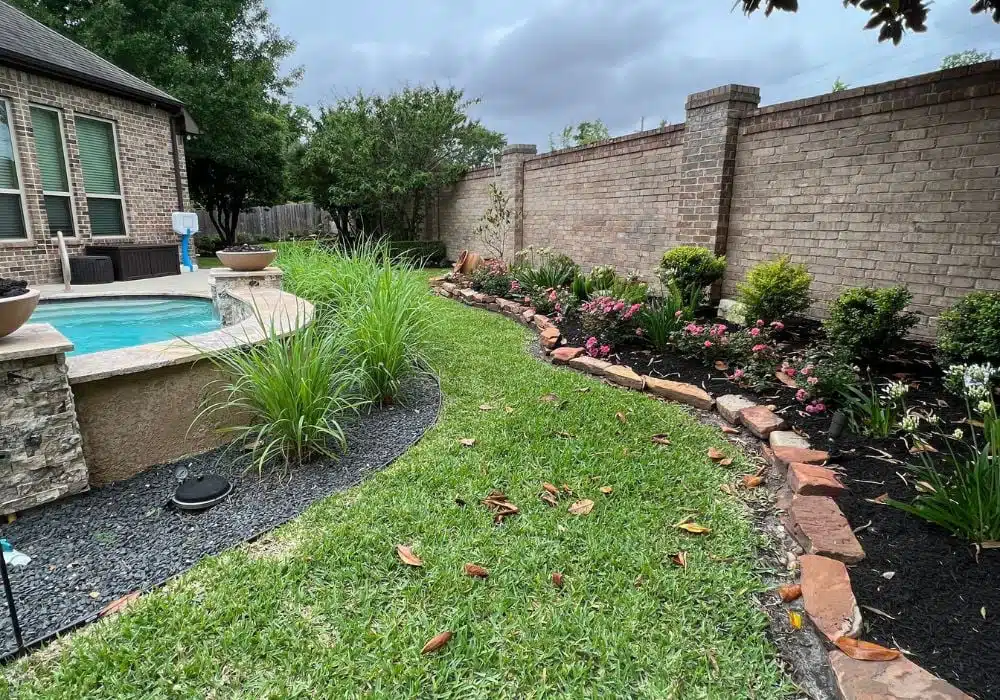 Proper mowing height and a tidy lawn help your grass handle storm conditions and recover faster afterward.
If several inches of rain are in the forecast, your irrigation system should not be adding to it. This ties directly into the condition-based watering philosophy we use across our lawn care programs. Do not run the sprinklers simply because the controller's calendar says it is Tuesday. Read the weather, read the soil, and back off when nature is already doing the work.
We are not going to give you a universal rule like "turn sprinklers off for three days before a storm." The right answer depends on how much rain is forecast, how dry the soil is right now, and how well your lawn drains. The principle is simple. If heavy rain is coming, let it do the watering. For the full condition-based framework, see our St. Augustine care guide, which breaks down how to read the lawn instead of the calendar.
CenterPoint Energy tells Houston-area customers to stay at least 10 feet away from overhead power lines and to never attempt to trim vegetation growing on or near them. Any tree work within that distance requires trained line-clearance professionals and may need coordination with the utility itself. If you have a tree limb growing into or near a power line, do not cut it yourself. Contact your utility provider through their vegetation-management process and let them handle it.
This is the line where ordinary yard work ends and specialized work begins. If a tree on your property is near utility lines, that is not a task for a general landscaping crew either. It requires a line-clearance tree trimmer with the right qualifications and insurance. Trying to save money on this is how serious injuries and property damage happen.
Before the weather arrives, walk the property with your phone and photograph everything. Trees, fences, beds, hardscaping, drainage areas, outdoor structures, equipment, and any major landscape improvements. The goal is documentation of the pre-storm condition of your property.
This is not about promising insurance coverage, and we are not in a position to tell you what your policy does or does not cover. Photographs simply give you a clear record of what the property looked like before the storm, which is useful for any after-the-fact conversation with your insurer. Take wide shots and close-ups. Store them somewhere they will not be lost if your phone is damaged.
When a storm is within 24 hours of arrival, the preventative work is done. What is left is a final sweep to confirm everything is secured. This is the checklist to walk through before you turn your attention to indoor preparations:
For actual emergency instructions, evacuation routes, and shelter information, follow ReadyHarris and the National Hurricane Center. Evergreen is not the authority on evacuations or storm sheltering, and this guide does not replace those sources.
Once the storm has passed, the instinct is to get outside and start fixing things. That instinct is where a lot of injuries happen. Texas A&M Forest Service specifically warns that recovery injuries are common after storms and recommends caution around downed utilities and hanging limbs. They also advise bringing in qualified professionals for significant tree damage rather than handling it yourself.
Before you start cleanup, look for downed power lines and assume every downed wire is energized. Stay at least 35 feet away from the line and from objects it may be touching, and report it to your utility provider. Look up for hanging limbs that are still partially attached and could drop without warning. Photograph the damage before you disturb major areas, where practical, so you have a record for any insurance conversation.
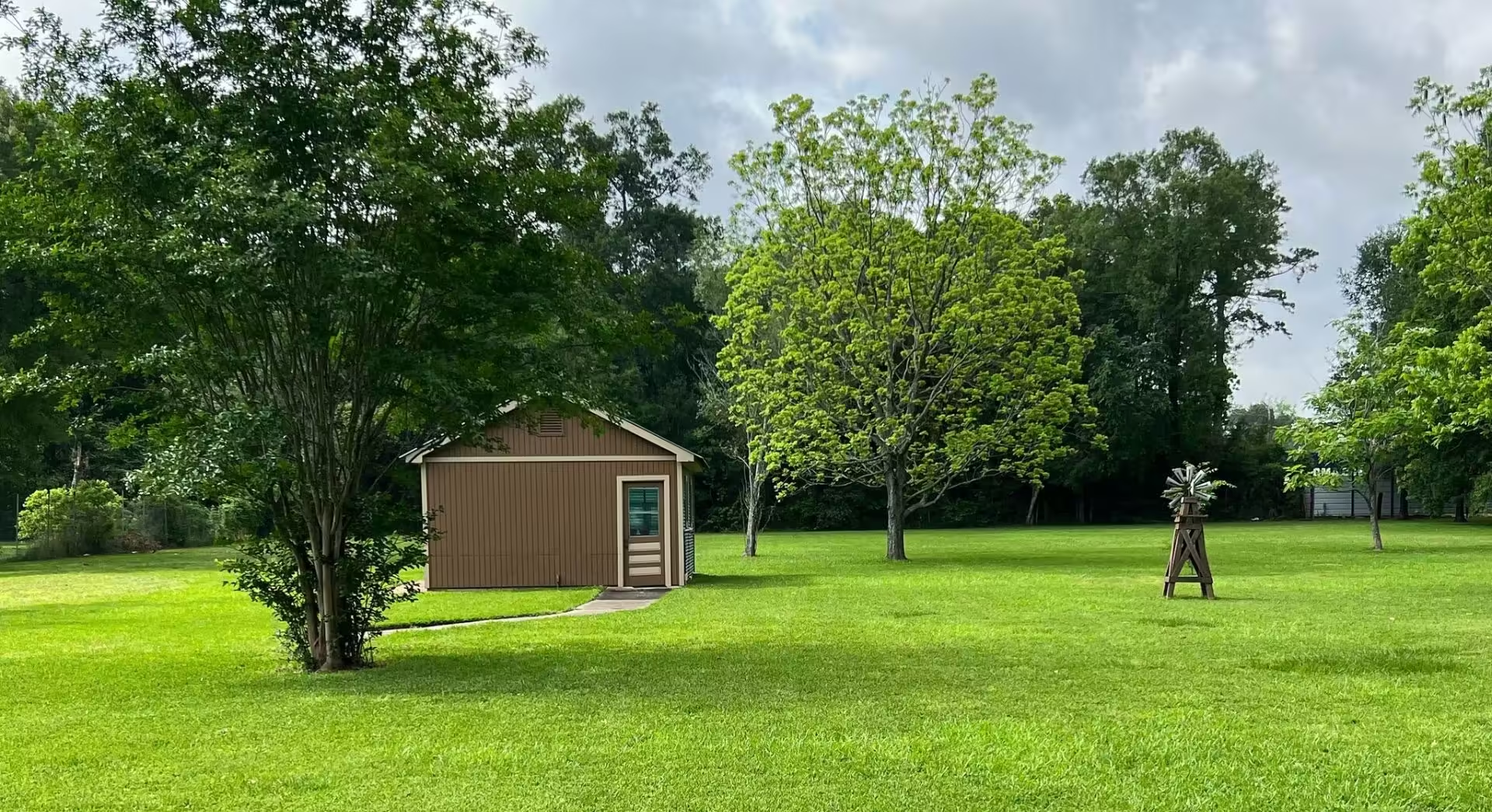 After the storm, assess damage safely and document conditions before beginning any cleanup work.
Do not rush heavy equipment onto saturated lawns. A truck or bobcat that would be fine on dry ground can rut a soft Houston lawn deeply enough to require repair. Restore blocked drainage only where it is safe to do so, and get qualified help for any tree damage that involves large limbs, structures, or utility lines. For larger debris loads, overgrowth, branches, or a property that needs a full reset after the storm, see our property cleanup service and Houston yard cleanup guide. If a tree came down entirely, our stump grinding guide explains what happens after removal.
Evergreen Outdoor Services publishes this guide for general educational purposes only. It is not an emergency-management document and does not replace official storm instructions, evacuation orders, or weather alerts from ReadyHarris, the National Hurricane Center, or your local government. Tree work near structures or power lines involves inherent risk and may require a certified arborist or your utility provider before any work proceeds. Property owners should verify that any contractor they hire carries appropriate insurance, qualifications, and any coverage required for the work being performed. Evergreen Outdoor Services is not liable for decisions made based on the information in this guide. For a scope-specific evaluation of your property, request an outdoor property estimate.
If your outdoor checklist uncovered overgrown areas, tree work, drainage concerns, accumulated debris, or maintenance that has been pushed off, Evergreen Outdoor Services can help evaluate the applicable scope and get the property back under control before the next major weather event.
Call us at 832-506-8239 or request your estimate online.
Trees with structural, health, or utility-line concerns may require a certified arborist or utility provider before work proceeds.