
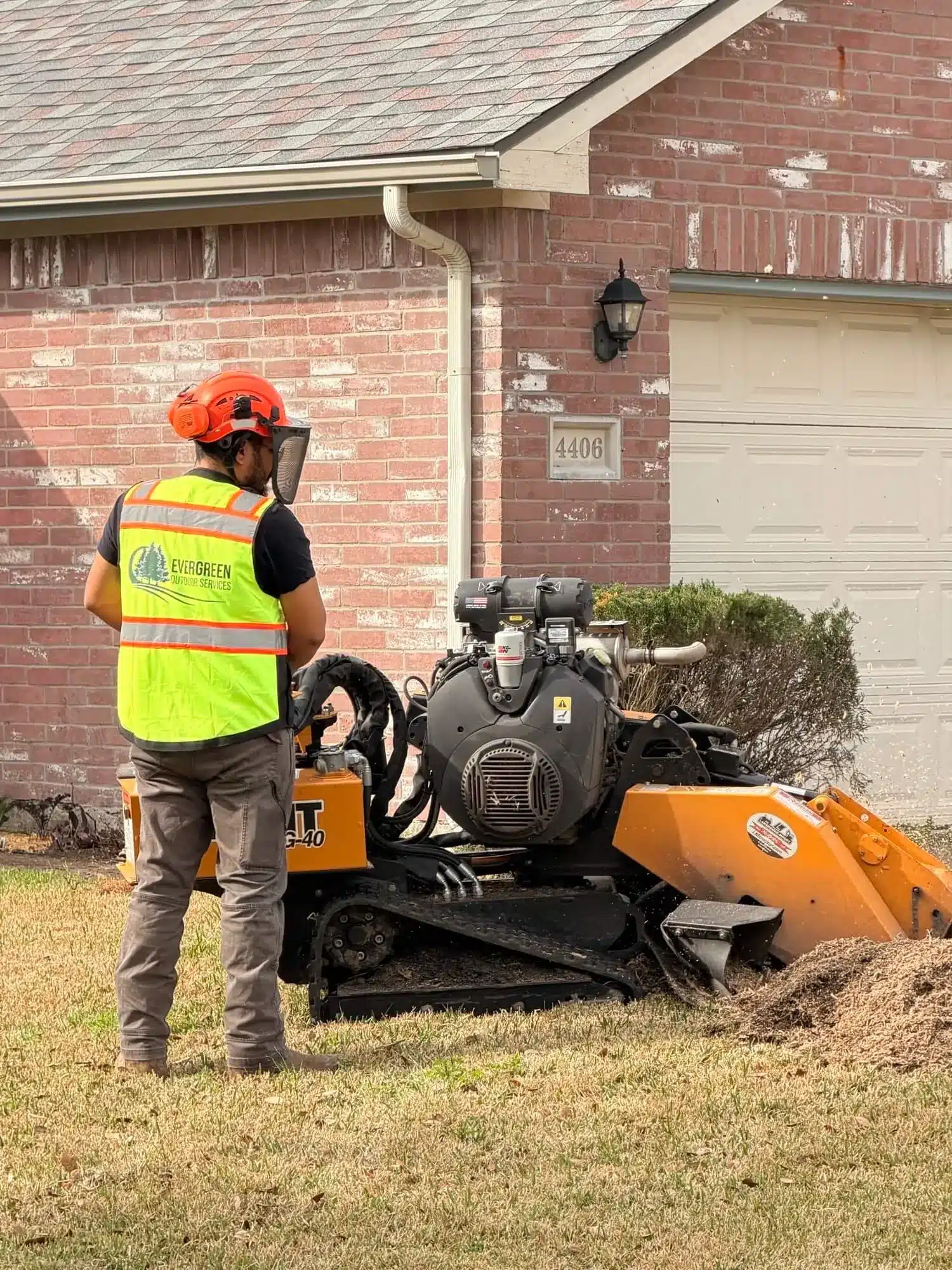
You finally cut down that leaning pine or dead oak, but now you're staring at a twelve-inch-high reminder of the tree that was. It's an eyesore, a mowing obstacle, and eventually, a biological time bomb. In Houston, the conversation usually turns to stump grinding vs removal. Homeowners often ask if they can just leave it to "rot away naturally." The reality is that in our Gulf Coast climate, "rotting naturally" is a polite way of saying you're building a five-star hotel for Formosan termites — and those termites don't stay in the yard.
The core difference: stump grinding uses a high-speed machine to chew the wood into fine mulch several inches below grade, while full stump removal uses an excavator to rip the entire root ball out of the earth. For 95% of Houston residential properties, grinding is the superior choice — less destructive to your yard, less expensive, and safer for existing drainage and foundation walls.
A stump doesn't just block your mower — it halts the entire potential of that section of your yard. Most homeowners can't picture the space without it until it's gone. What follows a professional stump grinding is immediate: a clean, level surface that can be seeded, sodded, or landscaped within days.
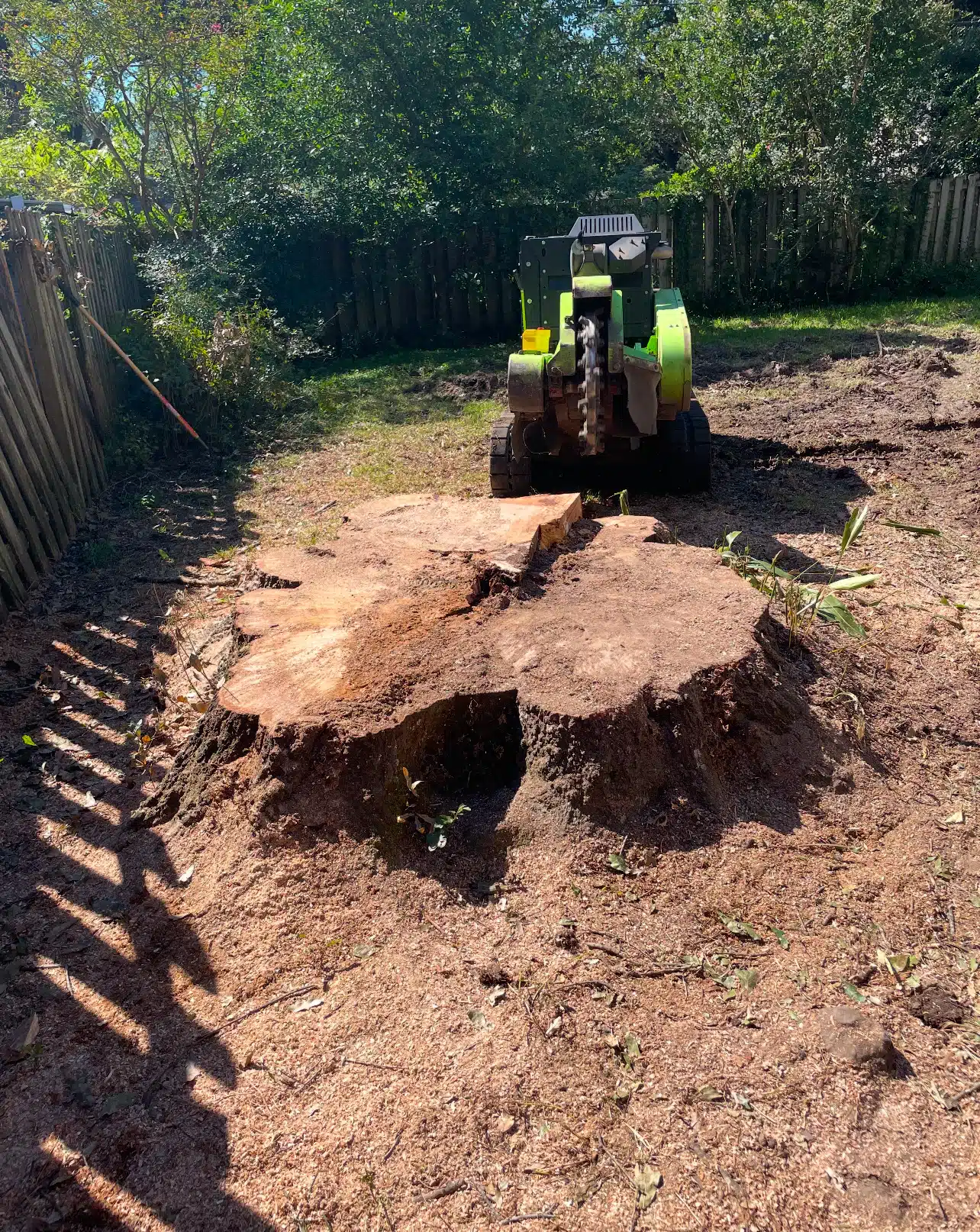 Before: A large stump creates a dead zone where grass cannot grow, equipment cannot pass cleanly, and decomposition begins building a biological risk below the surface.
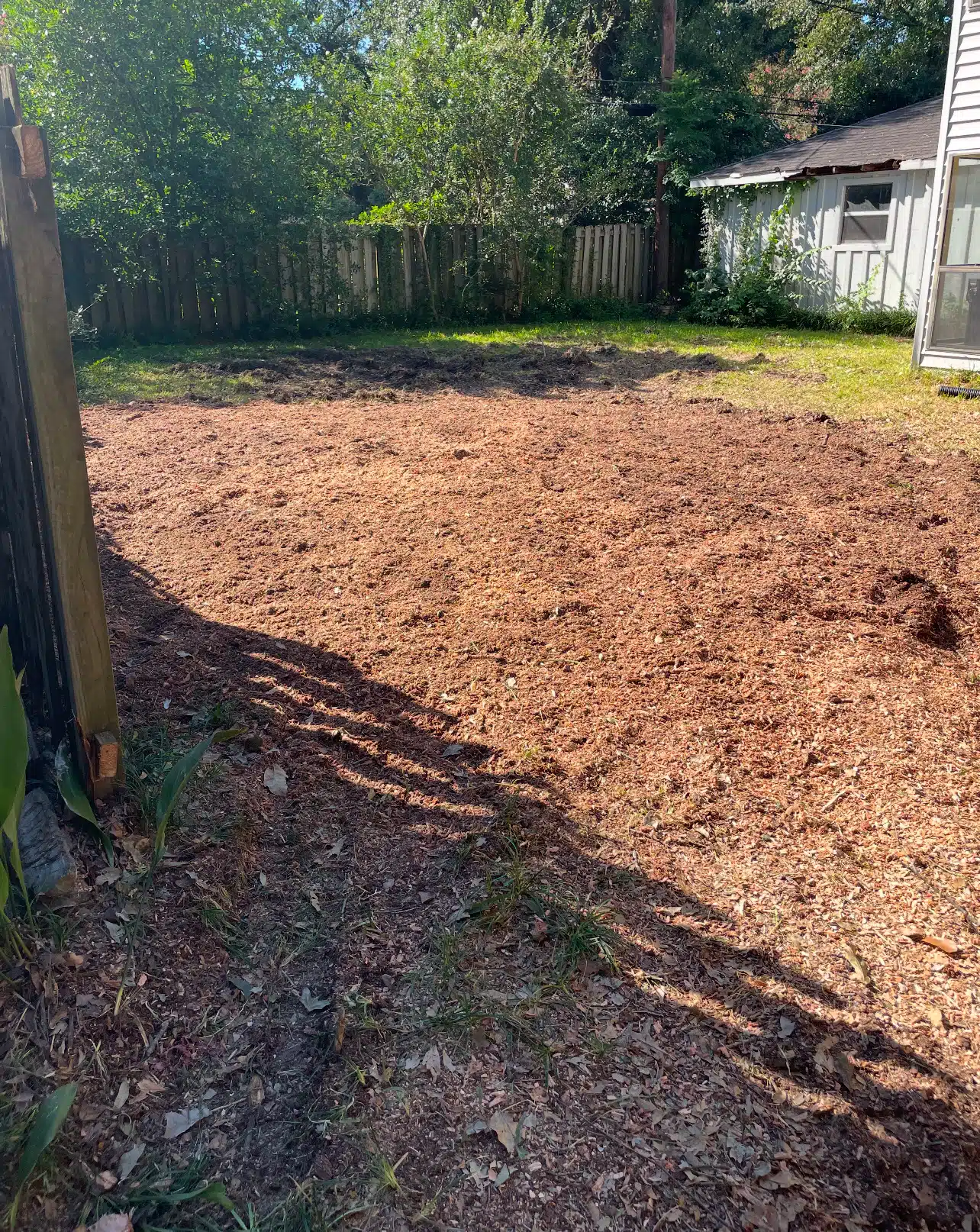 After: Ground flush, mulch removed, surface leveled. This area was ready for sod installation within 48 hours of the grind.
A stump isn't just a piece of wood — it's a dense, silica-heavy anchor with a root flare that spreads well beyond what you can see above ground. Professional grinding uses a machine equipped with a heavy spinning vertical wheel lined with carbide-tipped teeth. The operator sweeps the wheel across the stump in overlapping passes, shaving down layer by layer until the grind reaches 8 to 12 inches below grade.
I see this misunderstood all the time in Kingwood and Atascocita: homeowners think the stump stops at the soil line. It doesn't. A 20-inch pine has a massive flare that extends underground. Grinding creates a bowl of fine wood chips that, once removed or mixed into the surrounding soil, leaves a stable, level surface. No crater. No equipment ruts across the lawn. No torn-up fence line.
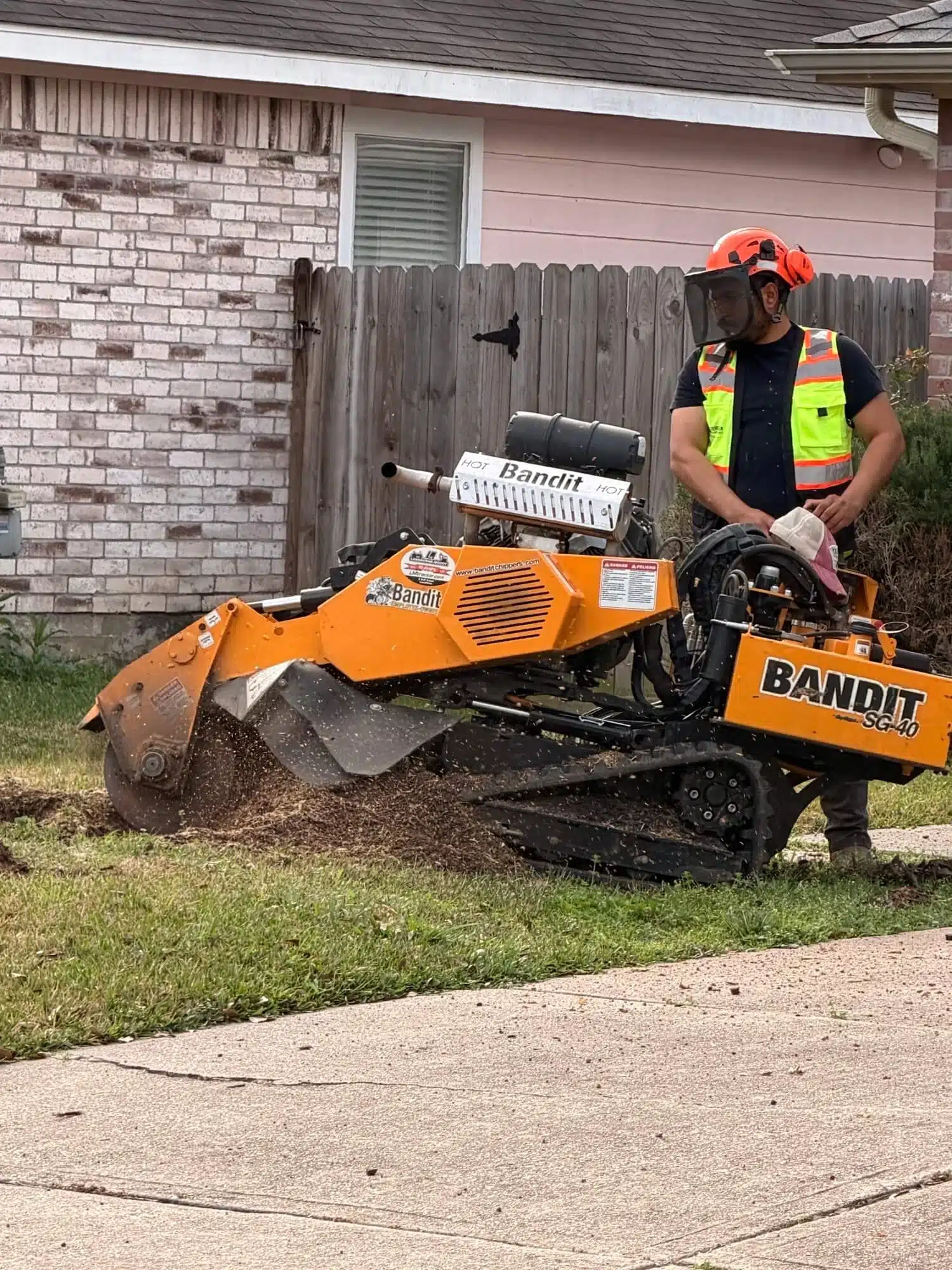 Carbide teeth at speed: the grinder shaves in overlapping passes, reaching 8 to 12 inches below grade — deep enough to prevent regrowth and remove the termite food source.
The finished result is a mulch pile that's often three times the diameter of the original stump. That material either gets hauled off as part of the cleanup, used as garden bed cover, or worked into the surrounding soil. For properties planning to resod, we always recommend a complete site cleanup and topsoil leveling before any turf goes down.
Here's where most people mess up when comparing costs. Full stump removal sounds like the "cleaner" solution. In practice, it's high-impact surgery on your yard — and in Houston's Houston native clay, the collateral damage is significant.
To pull a root ball, we need an excavator. That machine needs access. In most Houston neighborhoods, access alone is a $500–$800 conversation before the stump ever comes out. Once we're in, pulling the root ball doesn't just remove the stump — it removes a massive volume of the clay attached to it. A 24-inch pine stump comes out with a root ball the size of a compact car. What remains is a crater 4 to 6 feet deep, with unstable walls of wet clay that will collapse inward with the first heavy rain.
Backfilling that void correctly — compacting the clay in layers, not just dumping dirt in — adds time and cost. If it's done quickly or carelessly, you'll have a depression in your yard two seasons from now that no amount of top-dressing will fully fix. Unless you're breaking ground for a new concrete pad, pool, or foundation work, the disruption to your yard's grade and drainage is almost never worth it over a professional grind.
This is the part most homeowners don't hear until it's too late.
In Houston's humidity, a rotting stump is not a passive eyesore. It's an active biological event. Subterranean termites — the same species responsible for hundreds of millions of dollars in structural damage across the Gulf Coast every year — are drawn to damp, decaying wood in direct soil contact. A rotting stump sitting in Houston native clay, kept consistently moist by our rainfall patterns, is exactly the environment they're looking for.
The problem isn't just the stump. Termites don't stay put. Once a colony establishes in the stump, they follow the existing root lines outward through the soil. In many Houston properties, those roots extend 10 to 20 feet from the tree base — sometimes pointing directly toward a home's foundation or pier beams. Grinding the stump eliminates the solid wood structure the colony needs to establish and grow. Chips decompose faster and don't support the same organized colony structure that a solid stump does.
Leaving a stump to "rot naturally" is, in this climate, a delayed payment on a much larger problem. If you've already seen signs that a tree needs removal, the stump conversation starts the moment the tree comes down — not six months later. Once the tree is down, stump grinding should follow quickly to eliminate the biological and structural risks that accumulate over time.
Houston soil is its own adversary. As a stump rots over 5 to 10 years, it leaves a progressively larger void below the surface. The clay above that void stays structurally intact until it doesn't — and when the April Deluge hits and the ground becomes a sponge, the weight of saturated clay above a rotting core will collapse suddenly. I've seen mower wheels get swallowed and ankles twisted in these stump sinkholes. Kids and pets don't see them coming at all.
The physics of grinding avoids this entirely. When wood chips are mixed into the surrounding clay, you're creating an organic-heavy transition layer that settles predictably and feeds the soil biology. There's no void. No collapse event. Just gradual, stable decomposition that actually improves soil structure over time — which matters when you're dealing with compacted Gumbo that already resists water penetration. For properties in Cypress, Katy, and Sugar Land where the clay is at its worst, this is a meaningful long-term difference.
| Factor | Stump Grinding | Full Root Ball Removal | "Natural" Rotting |
|---|---|---|---|
| Time to Complete | 1–2 hours on-site | Half day to full day | 5–10 years |
| Yard Disruption | Minimal — machine path only | High — excavation crater, ruts | None initially, then sinkhole |
| Termite Risk | Very low — wood chips decompose fast | Zero — root structure gone | Extreme — solid food source for years |
| Houston Equipment Access | Compact units fit through 36" gates | Requires excavator — may need fence removal | No access needed |
| Sod or Landscape Ready After | Within 48 hours with cleanup | After proper backfill and settling (weeks) | Not until fully rotted — years |
| Relative Cost | Moderate — best value for most jobs | Significantly higher | $0 now, expensive problem later |
| Best Fit | Standard residential — 95% of cases | New construction, pool dig, foundation pour | Not recommended in Houston |
In The Heights and Montrose, the constraint is almost always access. Zero lot lines, 36-inch gates, and tight alley configurations mean a full-size excavator has no realistic path to the backyard without taking a fence section down first. Our compact track grinders are built for exactly these lots — they fit through a standard single gate and can work within 18 inches of a fence line without contact.
In The Woodlands and Kingwood, pine stumps carry an additional soil chemistry problem. Pine needles acidify the surrounding soil as they break down, and a rotting pine stump accelerates that process in the immediate area. Left unaddressed, the 8 to 10 foot radius around a decaying pine stump can develop soil chemistry that suppresses turf growth for years — even after the visible wood is gone. Post-grind, we typically recommend a soil assessment and pH correction before any sod or turf installation in those areas. Our broader guide on Zoysia grass care in Houston covers how soil chemistry affects premium turf varieties.
In Memorial and River Oaks, the issue is often the canopy. When a large live oak comes down, the root system is enormous — sometimes extending 30 to 50 feet from the base. Full removal of those roots isn't realistic or necessary for most residential situations, but understanding where the surface roots run matters before any new landscape installation begins in that zone.
The grind is the beginning, not the end. Here's what the next steps look like depending on your goal. If you're coordinating stump grinding with other yard work, timing and sequencing matter — we can help coordinate the full plan.
 Understanding your grinding estimate: breakdown of labor, equipment, cleanup, and follow-up options — so you know exactly what comes next.
For any grind that's part of a larger yard reset or landscape project, our landscape maintenance team can coordinate the follow-up work so you're not managing multiple contractors for a single project.
The standard is 8 to 12 inches below grade. This depth clears the main root flare, removes the termite food source, and allows healthy turf to establish above it. Going deeper than 12 inches adds cost and time without meaningful benefit for most residential applications — and increases the risk of hitting utility lines that run at medium depths. If you're unsure what's buried in your yard, 811 should be contacted before any grinding begins.
Not in the exact same footprint, at least not immediately. The deep primary roots remain in place after a grind and will compete with a new root system for several years. For a new tree in the same 12-inch circle, full removal is the right call. For a new tree planted 4 to 6 feet away from the original stump location, a grind creates no meaningful interference and the new planting can proceed normally. Planning a new landscape installation after grinding? We can handle both in one coordinated project.
Without the stump as an energy source, the root system stops growing and gradually decays into organic matter — a process that actually feeds the surrounding soil over the next few seasons. The exception is certain sprouting species like crape myrtles and some oaks, which can push new growth from remaining surface roots. For those species, a targeted root treatment after grinding prevents regrowth without requiring full excavation. If you're unsure whether your tree qualifies for regrowth risk, check our guide on when a tree actually needs removal.
Serious enough to treat as a timeline, not a theory. Subterranean termites are active in our soil year-round in Houston's climate, and a damp, decaying stump in direct clay contact is exactly what they seek. The risk increases significantly once the stump begins to show visible rot or mushroom growth — both signs that the decomposition process is advanced enough to support colony activity. The root lines from that stump can lead termites toward your foundation.
A fair pushback: "Won't the deep roots still decompose?" Yes — but there's a critical difference. A solid stump at grade level is constantly rewetted by rain, stays accessible to moisture, and rots fast enough to support an organized colony structure for 5 to 10 years. Deep roots below 12 inches decompose slowly, in isolated pockets, without the energy advantage of a trunk that collects water. That scattered, slow decomposition doesn't create the stable environment a termite colony needs to establish and grow. It's the difference between a solid wood block in a wet bathtub (active problem) and scattered roots slowly breaking down 18 inches underground (passive, slow process). Grinding removes the bathtub; the deep roots are just roots doing what roots do naturally. That's why grinding sooner rather than later is the practical choice in this market.
A standard residential stump produces a mulch pile that's often three to four times the visible size of the original stump. That material can be hauled off, used as temporary garden bed cover, or worked into the surrounding soil. For properties planning to resod or landscape over the area, we recommend full chip removal and topsoil backfill for the cleanest, most stable finished surface. This is especially important if you're planning new sod installation — proper site prep is what makes the difference between success and failure. See our property cleanup service for complete post-grind site restoration.
Yes, when performed correctly. The grinding machine works above and slightly below grade — it's not excavating or creating lateral pressure against nearby structures. The more relevant foundation concern is actually the opposite: leaving a large stump to rot within 10 to 15 feet of a foundation allows root decay to create subsurface voids that affect soil stability over time. Grinding removes that risk by accelerating decomposition in a controlled way. If you're concerned about foundation stability or yard drainage around a stumpy area, our drainage solutions guide covers how to evaluate and address water movement near structures.
A stump that looks like a minor inconvenience today is a termite risk, a drainage problem, and a sinkhole waiting to happen in Houston's climate. The grind is one of the highest-ROI decisions you can make for a yard that's already been through a tree removal.
We've ground stumps in tight Heights backyards, massive Katy open lots, and pine-heavy Woodlands properties. Whether you need tree removal followed by grinding, or just stump grinding on its own, the equipment, the access plan, and the follow-up cleanup are all part of the job.