
Yard drainage cost in Houston typically runs between $1,800 and $12,500+, depending on job size and complexity. Most of the jobs we complete fall somewhere in that range — the spread exists because drainage pricing isn't driven by a flat price list. It's driven by your specific yard's physics: how far the water has to travel to discharge, how hard the clay is to trench through, how many catch basins are needed, and whether the lawn has to be restored afterward.
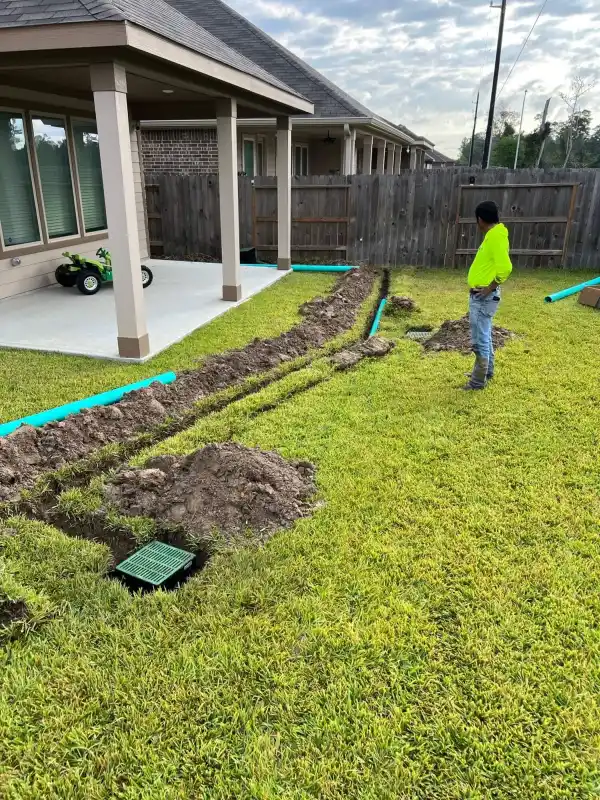
The problem isn't the puddle. It's what that water is doing under your soil — expanding clay, shifting grade, and slowly working against your foundation with every storm. The national averages you'll find online don't capture that. Houston's expansive clay soil, flat lot grades, and heavy rainfall cycles make drainage work consistently more labor-intensive than comparable jobs in other parts of the country. This guide explains why — and what a realistic budget looks like for each type of fix.
Two Houston yards with identical square footage and identical symptoms — standing water after rain — can have drainage quotes that differ by $3,000 or more. That's not contractors pricing differently. That's the actual difference in what the jobs require.
These are the variables that move the number most:
Where does the water actually go? The further the pipe has to run to reach a street curb, drainage channel, or rear easement, the more pipe, labor, and trench work is required. A yard that discharges 20 feet to the curb is a fundamentally different job than one that has to run 80 feet to the back of the lot.
Houston's native clay is among the most difficult soil types in the country to trench through. When it's baked dry in August it can require mechanical equipment where other soils take a shovel. When it's saturated after a storm it becomes a slick, heavy excavation challenge. Either way, it adds labor hours that other regions simply don't have.
Each inlet point — whether it's a surface grate drain, a channel drain, or a yard basin — adds material and connection labor. A yard with one low spot needs one basin. A yard with four problem zones needs four basins and the connecting pipe network to tie them together. Each added basin typically adds $400–$900 to the total.
Standard corrugated perforated pipe is the baseline. Solid HDPE or PVC pipe, which is required in certain discharge runs and under hardscape, costs more. Deeper installations — needed when the trench has to go below a root system or utility line — add excavation time. The pipe that works for 18 inches of depth is a different spec from what's needed at 36 inches.
Connecting roof gutter downspouts to the underground drain system keeps high-volume roof water from dumping at the foundation line. Each tie-in adds $300–$900 depending on the distance to the nearest collection point. It's almost always worth it — roof runoff is a massive volume contributor to foundation-level pooling in Houston storms.
When the ground itself slopes the wrong direction, drainage pipe alone won't fix it. Regrading to establish positive drainage away from the structure is a separate scope item — and it's often the real fix. After any trenching, the disrupted lawn needs sod repair. Most homeowners underestimate this line item and are surprised when the quote includes it.
Equipment that speeds up trenching can't always reach a backyard through a gate or alongside a house. When mechanical trenching isn't possible, hand digging through Houston clay at depth is a significant labor add. Fenced urban lots in Montrose, the Heights, or Midtown are the most common constraint — narrow gates mean hand tools and more crew time.
Most Houston yards have underground irrigation systems. Any drainage trench has a real chance of crossing a sprinkler lateral line. Locating, protecting, and repairing hit lines is a legitimate scope item — a conscientious contractor accounts for it. Cutting through an unlocated irrigation zone and walking away is a different (and far more expensive for you) approach.
Not every trench line requires a full sod replacement — sometimes topsoil and seed is appropriate. But on St. Augustine yards (which is most of Houston), seed doesn't work the same way, and sod replacement along the trench line is standard. The variety matters: replacing a Zoysia trench line costs more than St. Augustine per foot of repair.
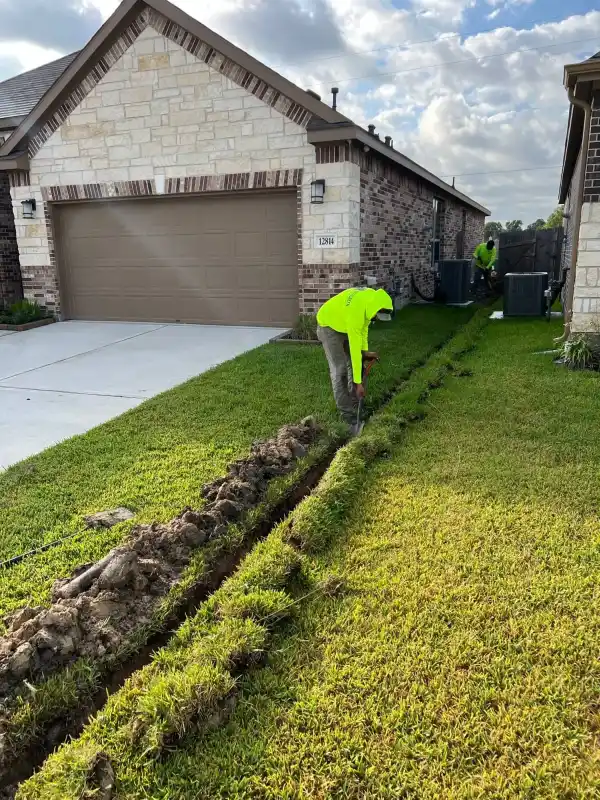 Trenching through Houston's dense clay soil is the single biggest labor variable on any drainage project. A flat-looking yard can hide 30+ inches of compacted material that mechanical equipment is required to move.
Many Houston neighborhoods — especially in Katy, Pearland, and Sugar Land — were built on land with almost no natural grade. When engineers designed the subdivisions, they created just enough slope to direct water to the street. Over time, soil settling, tree root systems, and years of lawn maintenance can destroy that engineered grade. If your yard held water since you moved in, you likely have a drainage design problem, not just a soil problem.
Choosing the right system before spending anything is the most important decision in this process. Installing the wrong system for your yard's specific condition costs as much as a correct install — and doesn't solve the problem. Here's a breakdown of what each system costs and when it's the appropriate solution.
| System Type | Typical Cost Range | Best For | What Drives Cost Higher |
|---|---|---|---|
| Surface / Channel Drain | $1,800–$3,500 | Driveway runoff, patio low spots, single pooling zone at grade | Concrete cutting, existing drain demo, utility conflicts, connection distance |
| French Drain (standard) | $3,500–$8,500 | Subsurface water, yard-wide saturation, water infiltrating from neighboring lots | Trench length, discharge distance, root systems, sprinkler lines, clay depth |
| Yard Basin / Catch Basin Network | $6,000–$12,500+ | Multiple pooling zones, mid-yard collection, tie-in to downspouts and French drain | Number of basins, existing infrastructure to demo, concrete cutting, pipe depth |
| Dry Creek Bed (decorative drainage) | $2,500–$6,500 | Visible water flow paths, naturalistic design, side yards with heavy sheet flow | Rock type, length, plant material, retention basin at terminus |
| Full Regrading + Drainage | $8,500–$15,000+ | Reverse-slope lots, settling foundations, water against the house | Cubic yards moved, soil disposal, haul cost, obstacles, retaining needs |
| Downspout Underground Tie-In | $400–$1,200 per point | Foundation-line pooling from roof runoff, downspout extension failures | Distance to drain system, pipe size, concrete penetration, hardscape routing |
For a technical breakdown of the two most common systems and which situation calls for which, see French drain vs surface drain in Houston — it covers the decision in depth before you spend anything.
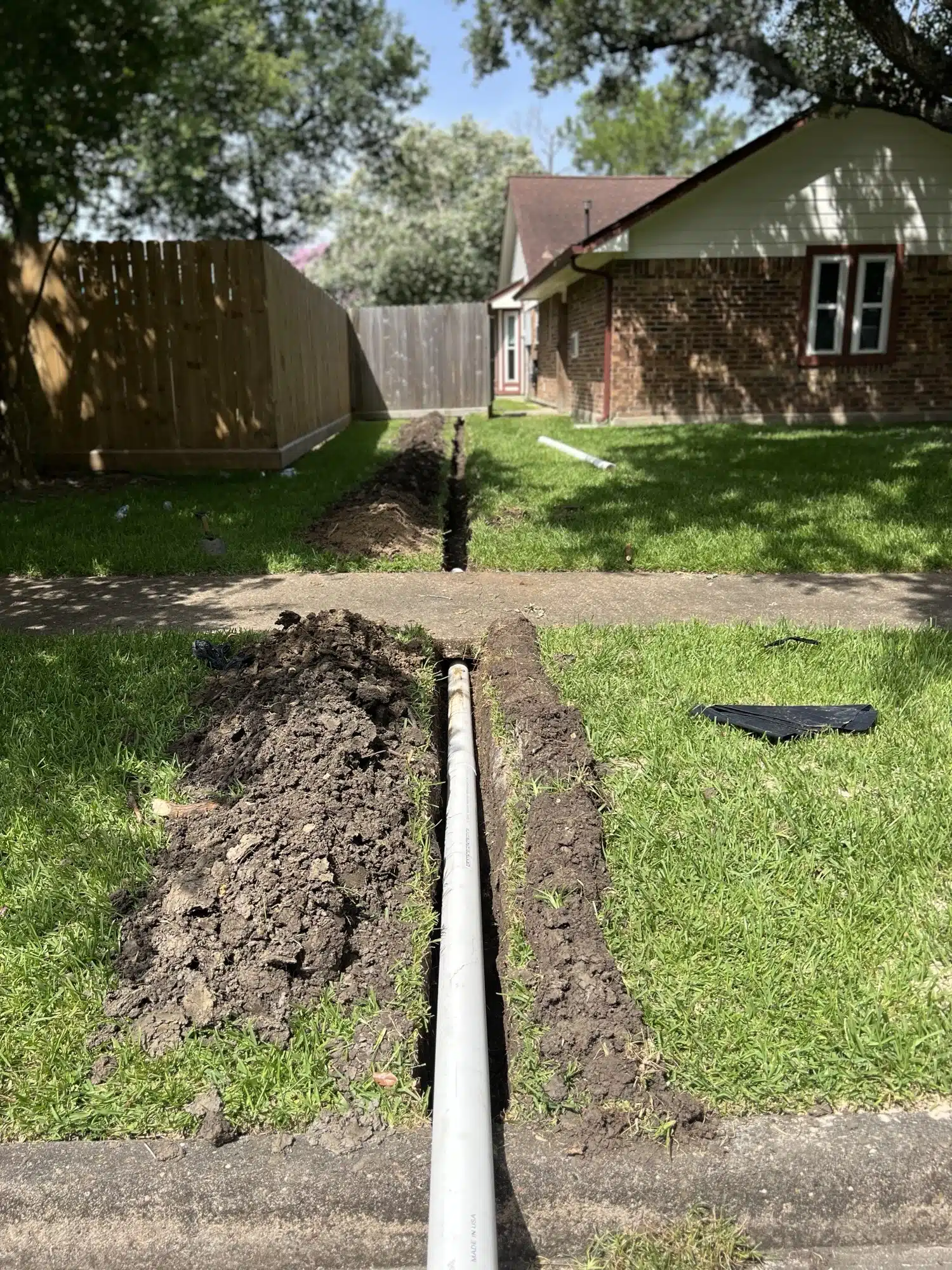 Pipe bedding, gravel spec, and trench slope are invisible after install — and the first place corners get cut on low-bid drainage jobs.
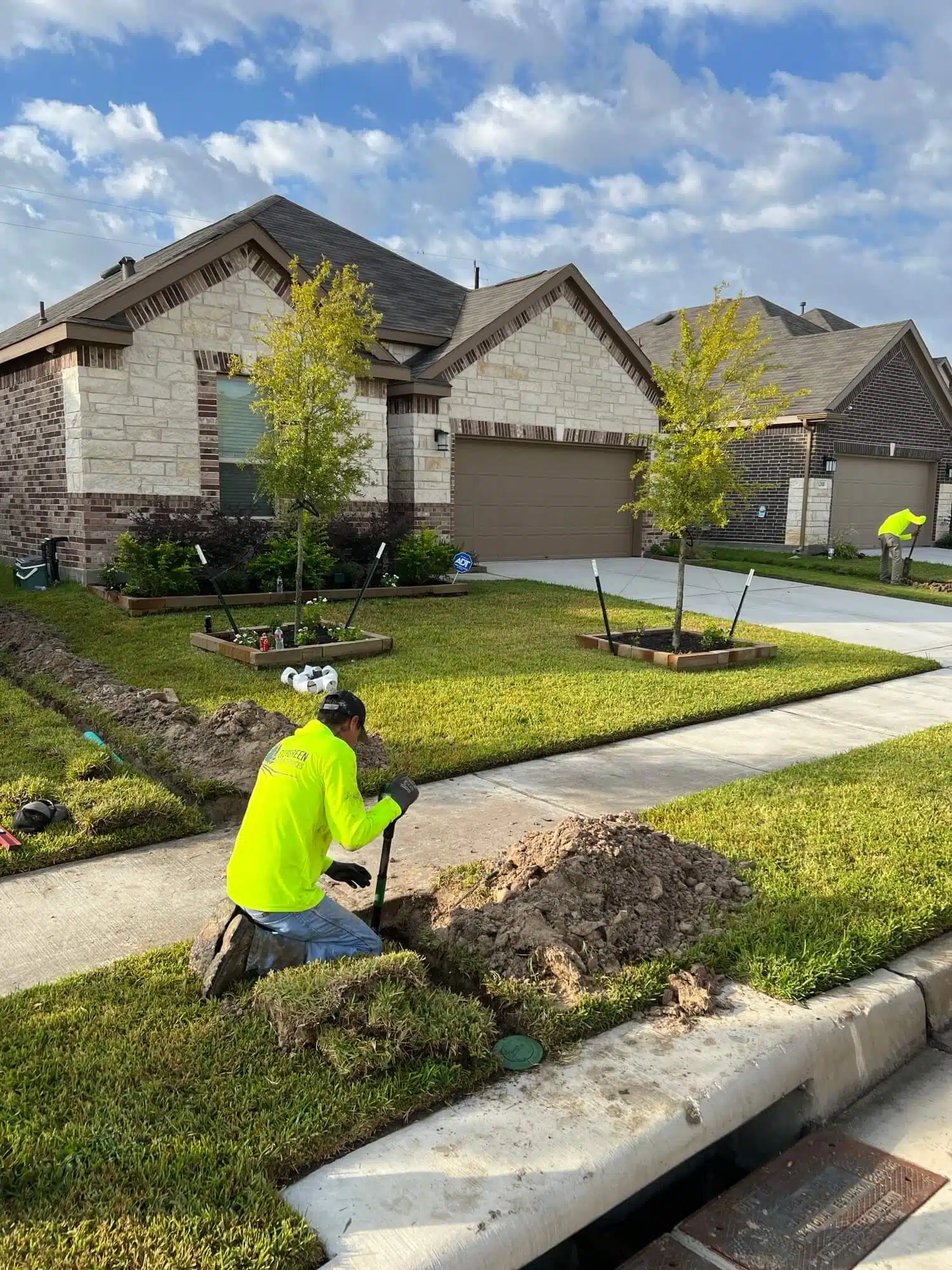 Front yard trenching complexity — every additional foot of pipe run and every directional change in the layout adds to the final cost.
Beyond the system type, these are the specific site conditions that consistently push drainage quotes toward the top of the range — or well above it.
Every foot of additional trench and pipe adds cost. A job that discharges 30 feet to a curb drain is a fundamentally different budget than one that needs to run 90 feet to a rear easement. Homeowners should expect $20–$40 per linear foot of installed drain pipe as a rough benchmark for the pipe run alone, before any basin costs. And sometimes the problem isn't even the yard — it's that the existing city curb drain is blocked or a resurfaced street now sits higher than the lot. Those situations add municipal coordination before any digging starts.
Houston's mature tree canopies are a selling point in neighborhoods like Memorial and Kingwood — and a real complication for drainage work. Trenching near established root systems requires slower, more careful excavation to avoid structural root damage, and sometimes the trench line must be rerouted entirely. Similarly, when drainage work happens near the house — particularly downspout tie-ins or perimeter French drains — the trench depth and pipe placement have to be managed carefully to avoid undermining the foundation footer. Houston's expansive clay soil makes this non-negotiable. The Houston drainage solutions guide covers what foundation-adjacent work should include.
Yard drainage cost in Houston is not a category where the lowest quote and the best outcome reliably come from the same contractor. Here's why.
Slope is everything. A French drain with inadequate slope doesn't drain — it becomes a water-logged pipe that sits full and backs up. The pipe needs a minimum fall of 1% (1 inch per 8 feet) to move water reliably. In a flat Houston lot, achieving that slope sometimes means digging deeper as you go, which takes more time. A quote that prices this job like flat-grade work is either wrong or cutting the slope requirement.
Filter fabric matters. Perforated pipe in Houston clay without proper filter fabric around the gravel bed will clog with silt within two to three rain seasons. The fabric is a cost item that some low-bid contractors skip or spec down. Once clay migrates into the gravel, the drain often fails faster than expected — and the fix typically means pulling it up and reinstalling correctly.
Gravel spec matters. Not all gravel is equivalent for drainage. Pea gravel has too much fines. Angular crushed stone at ¾ inch is the spec for proper French drain bedding. Using the wrong gravel reduces water movement through the system and accelerates clogging. You won't know this until two years later when the yard is wet again.
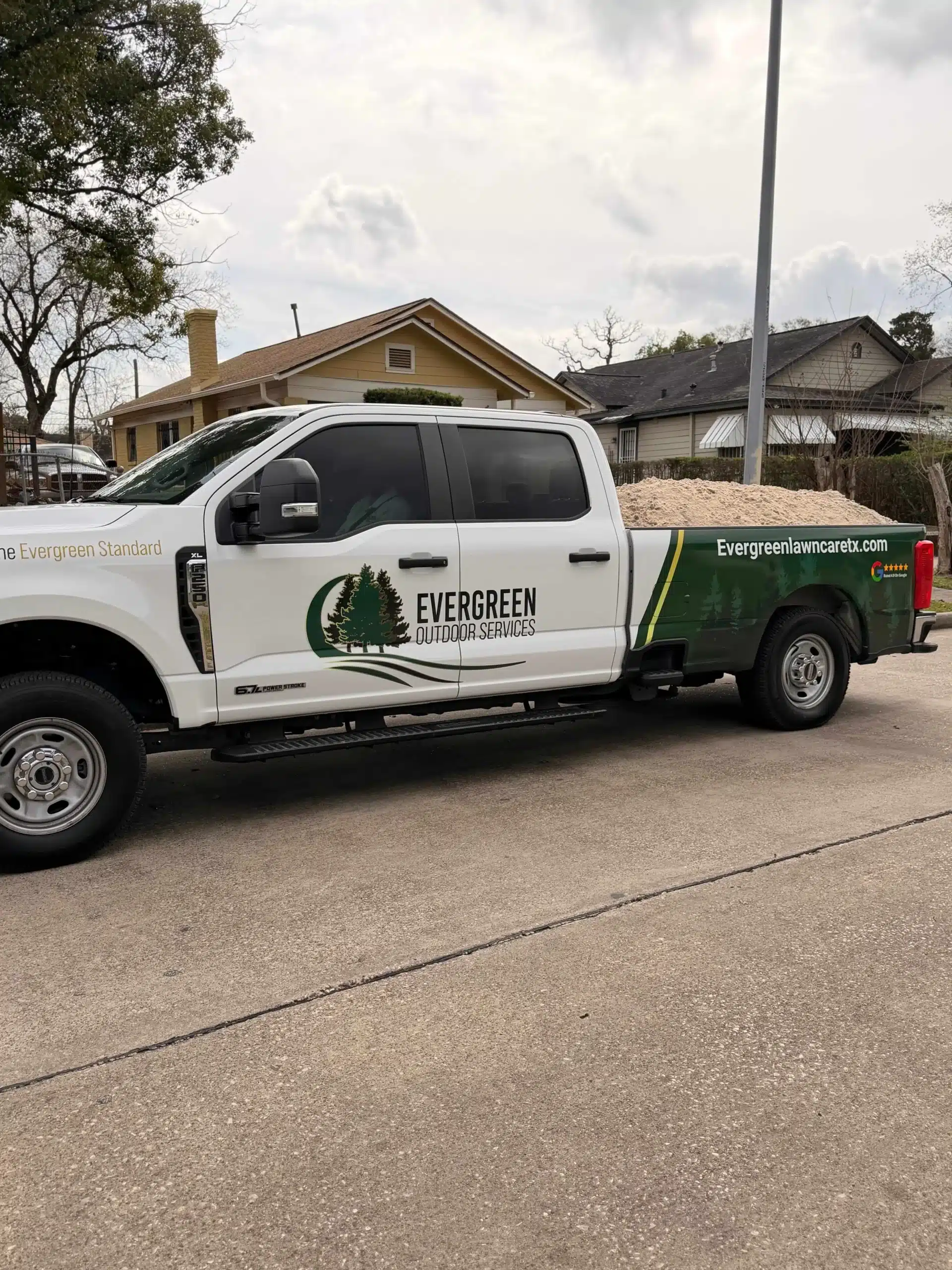 Sand delivery for grading and leveling — a hidden cost line that most drainage quotes don't show upfront until the job scope is fully scoped.
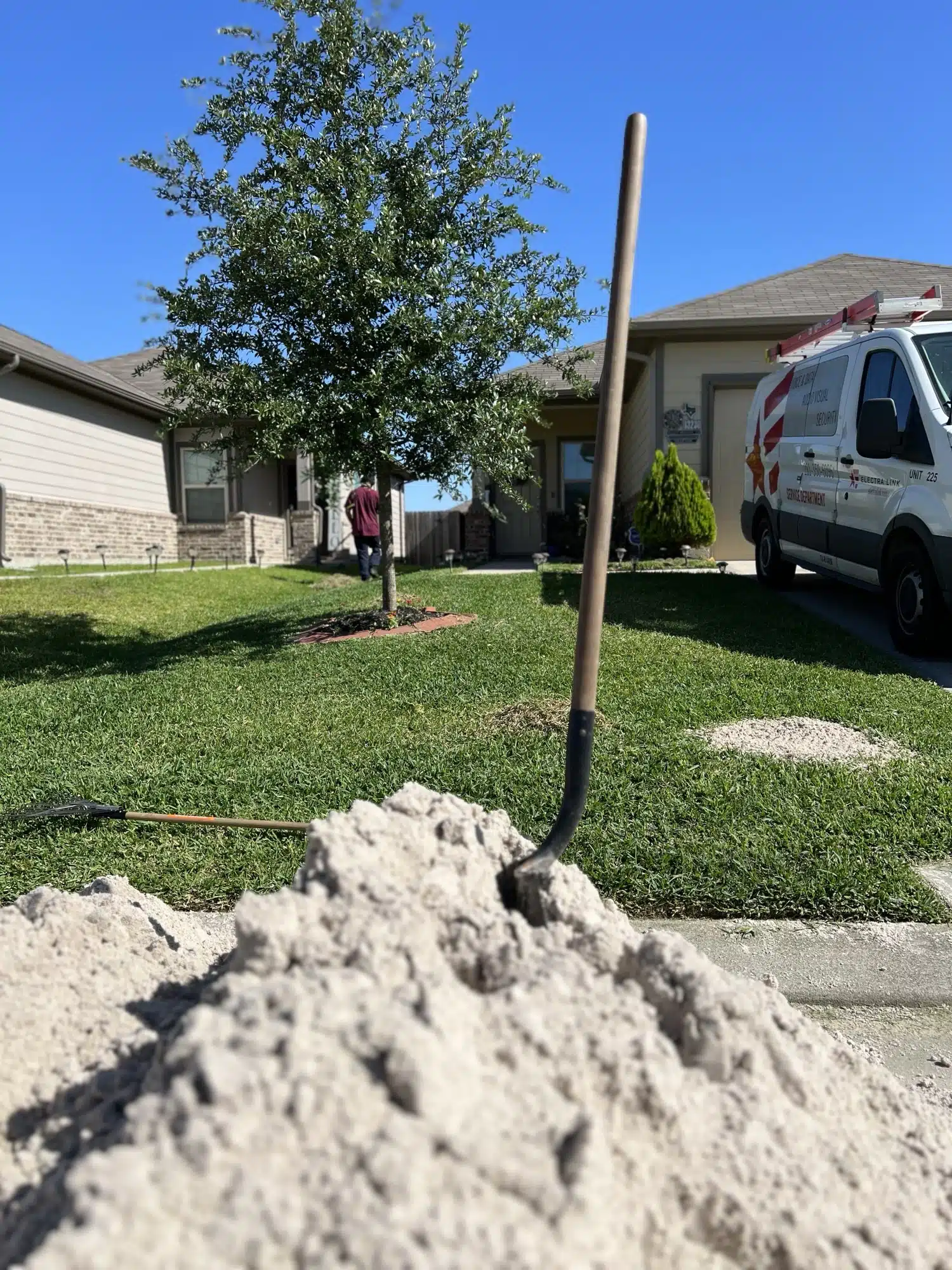 Lawn leveling after drainage work — nearly every project ends here. Budget it in before you start, not after the trench is already dug.
In some landscapes, dry wells can be a useful part of a drainage plan. In Houston, however, our clay-heavy soil can limit how quickly water is absorbed unless the system is tied into a genuinely permeable layer. Before moving forward, it is helpful to understand where the water will go once the surrounding soil is saturated. A strong drainage plan should be designed around a reliable discharge path and the specific soil conditions on the property.
A $3,000 French drain install sounds like a lot until you compare it to what ignoring drainage actually costs in Houston.
A $4,000 French drain amortized over 20 years is $200 per year. A $15,000 foundation pier repair is a one-time event that doesn't prevent the next one. The drainage fix addresses the root cause. Foundation repair addresses the consequence. These aren't equivalent costs.
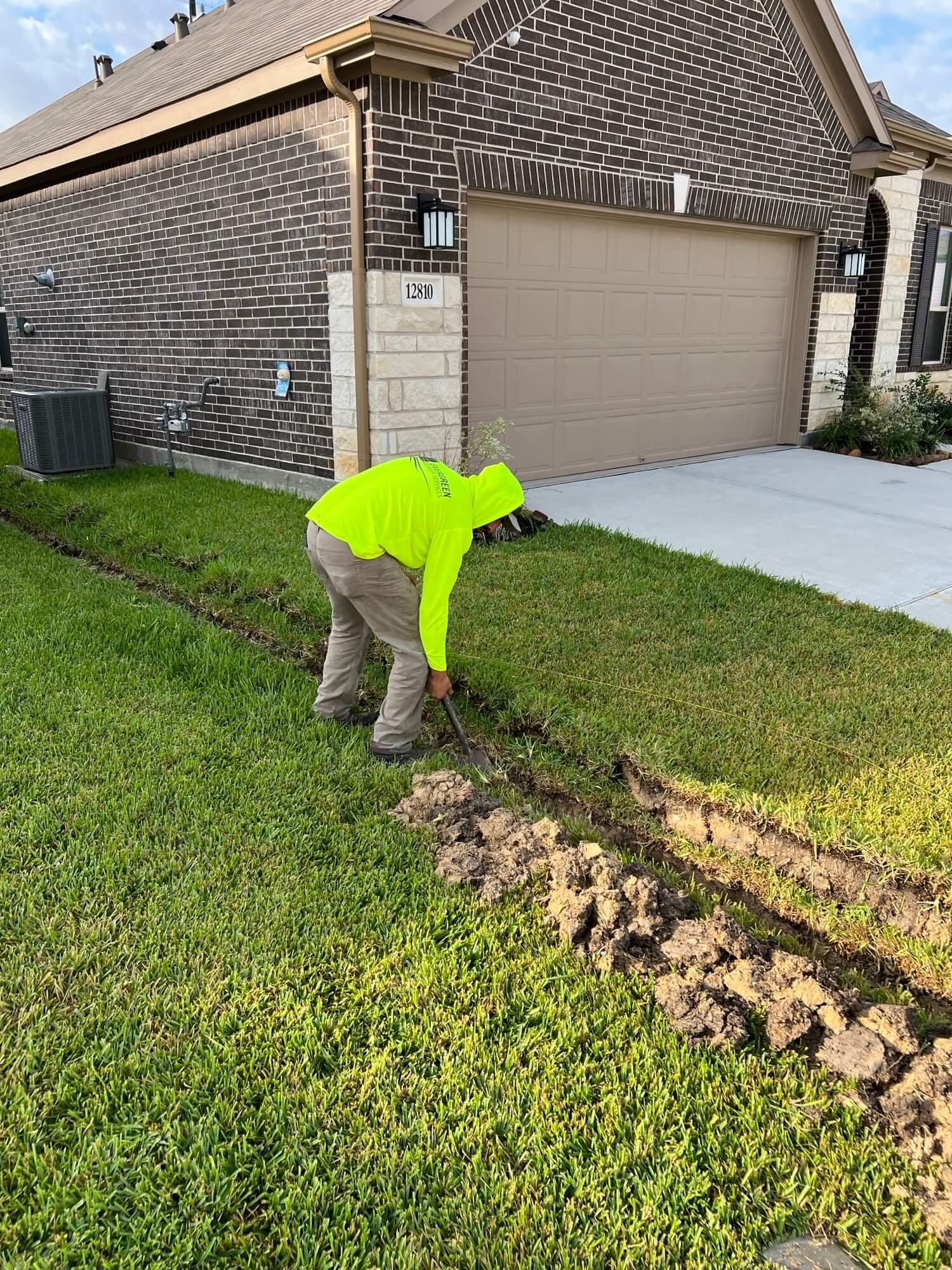 A completed drainage install in Kingwood — properly sloped, correctly bedded, and fully discharged. This is what a system that actually works looks like when the job is done right.
Not every wet Houston yard needs a $5,000 drainage system. Here's what actually justifies a lower-cost approach — and what those simpler fixes look like.
A single low spot collecting surface runoff. If the pooling zone is clearly defined, comes from surface flow (not subsurface saturation), and has a short, clear path to discharge, a single catch basin with a short pipe run to the curb may be entirely adequate. Straightforward jobs in this category run $1,800–$3,500. That number climbs if there's concrete to cut, an existing drain to demo, or sprinkler lines crossing the trench path — but it's still the most affordable end of the spectrum. Don't over-engineer what's genuinely a localized problem.
A downspout dumping at the foundation. One of the most common and most underestimated drainage issues in Houston. A gutter downspout that terminates 6 inches from the foundation slab during a 3-inch storm event is delivering enormous water volume to the worst possible location. Underground downspout extension to a curb drain is a targeted $400–$1,200 fix per downspout — more if hardscape penetration or utility conflicts are involved — that removes a major water source immediately.
A grade adjustment at a specific zone. Sometimes the problem is a small, localized low spot that accumulated from soil settling. Adding topsoil to restore positive grade — sloping away from the structure — and replanting over it is a low-cost fix that works when the problem is genuinely surface-level grade, not subsurface drainage capacity.
These are the situations where a simple fix won't hold and a properly engineered drainage system is the only durable solution.
Water against the foundation. If water is consistently sitting against the exterior foundation wall after rain, a French drain perimeter system or a foundation-adjacent catch basin network is required. A downspout extension helps but doesn't address subsurface infiltration or grade that directs surface flow toward the house. This is the situation where the cost-of-doing-nothing math matters most.
Multiple zones pooling throughout the yard. One low spot is a simple fix. Three low spots in different areas of the yard represent a grade and drainage capacity problem that requires a connected system — multiple inlets tied to a shared discharge run. The individual fixes would be cheaper per zone but don't address the underlying drainage capacity shortfall.
Subsurface saturation that lasts days after rain. If your yard feels soft and spongy for 48–72 hours after a rain event — even in areas that aren't visibly pooling — you have a subsurface drainage problem that catch basins alone won't solve. A French drain system positioned to intercept and redirect that subsurface water is the appropriate fix. See the full breakdown at Houston yard drainage solutions.
Water migrating from neighboring lots. In Houston's flat subdivisions, elevated neighboring lots and upstream drainage decisions can send significant water volume across your property line. This is a drainage engineering problem, not a landscaping problem — the solution involves intercepting that incoming water at the property boundary before it can reach low spots or the structure.
A drainage quote should not start with a random price per foot. It should start with a property walk. Before we recommend a system, we look at where the water starts, where it collects, how the yard slopes, where it can safely discharge, and what needs to be restored after trenching.
This is why two drainage jobs that look identical from the patio can price completely differently once the actual water path is mapped.
Smaller Houston drainage jobs run $1,800–$3,500. Mid-size French drain systems or multi-basin installs fall in the $3,500–$8,500 range. Large or complex jobs — those involving concrete cutting, existing drain demo, root systems, sprinkler conflicts, or long discharge runs — run $8,500–$12,500 and can go past that on larger properties. Clay excavation, discharge distance, and obstacles in the path are the biggest cost drivers. A quick site assessment is the fastest way to get a number that actually applies to your yard.
Not always. French drains work best when water is infiltrating from the sides or subsurface. If the problem is surface runoff collecting in a low spot, a surface drain or channel drain may be faster and less expensive. Choosing the wrong system wastes money without solving the problem. This is why we recommend a quick assessment before installing anything — the French drain vs surface drain guide covers how to read the difference before you spend anything.
Houston's dense clay soil is one of the most difficult to trench through in the country. It compacts hard, drains slowly, and requires more labor and often specialized equipment than softer soils. Combined with flat lot grades that force long discharge runs and Houston's heavy storm volumes, local drainage jobs consistently run above national averages for the same scope. This is largely driven by soil conditions and installation difficulty, not contractor pricing. A proper site walk shows exactly where your job falls in that range.
Simple surface-level fixes — redirecting a downspout extension, adding a channel drain to a driveway — are DIY-achievable. Anything involving trenching through Houston's dense clay, installing perforated pipe, or connecting to a city discharge point may require professional equipment and local approval depending on scope. A DIY French drain that isn't properly bedded, sloped, and discharged may stop working sooner than expected. If you're not sure which category your problem falls into, a quick assessment will tell you before you rent equipment or buy materials.
It depends on scope and municipality. In unincorporated Harris County, permits are often not required for residential drainage that stays on your property. In incorporated cities — Sugar Land, Pearland, The Woodlands — work connecting to a public drainage system or crossing a utility easement typically requires a permit. A reputable contractor knows the local requirements and handles that coordination so you don't have to.
Lawn restoration after drainage trenching typically runs $300–$1,500 depending on trench length, how much sod was disturbed, and which grass variety is being replaced. Most projects involve a narrow trench line with targeted sod repair. Full-yard regrading projects that strip the entire surface require a full sod installation on top of the drainage cost. Budget for it upfront — it's a near-universal line item, and a good contractor will include it in the quote from the start.
We'll walk your property, map the water path, and give you a clear, itemized plan that actually solves the problem — not a number pulled from a price sheet. No surprises after the trench is dug.
Call us at 832-506-8239 or request a drainage assessment online.