
Published May 2026 · Evergreen Outdoor Services · Houston, TX
Tree trimming cost in Houston is one of the most searched — and most misunderstood — questions in Houston home maintenance. The national average figures you'll find on most websites don't reflect what jobs actually cost here. Houston has some of the largest residential tree canopies in Texas, limited urban lot access, and a storm season that turns deferred maintenance into emergency calls. This guide gives you representative 2026 pricing from the Houston market — and explains exactly what moves the number up or down so you can evaluate any quote you receive.
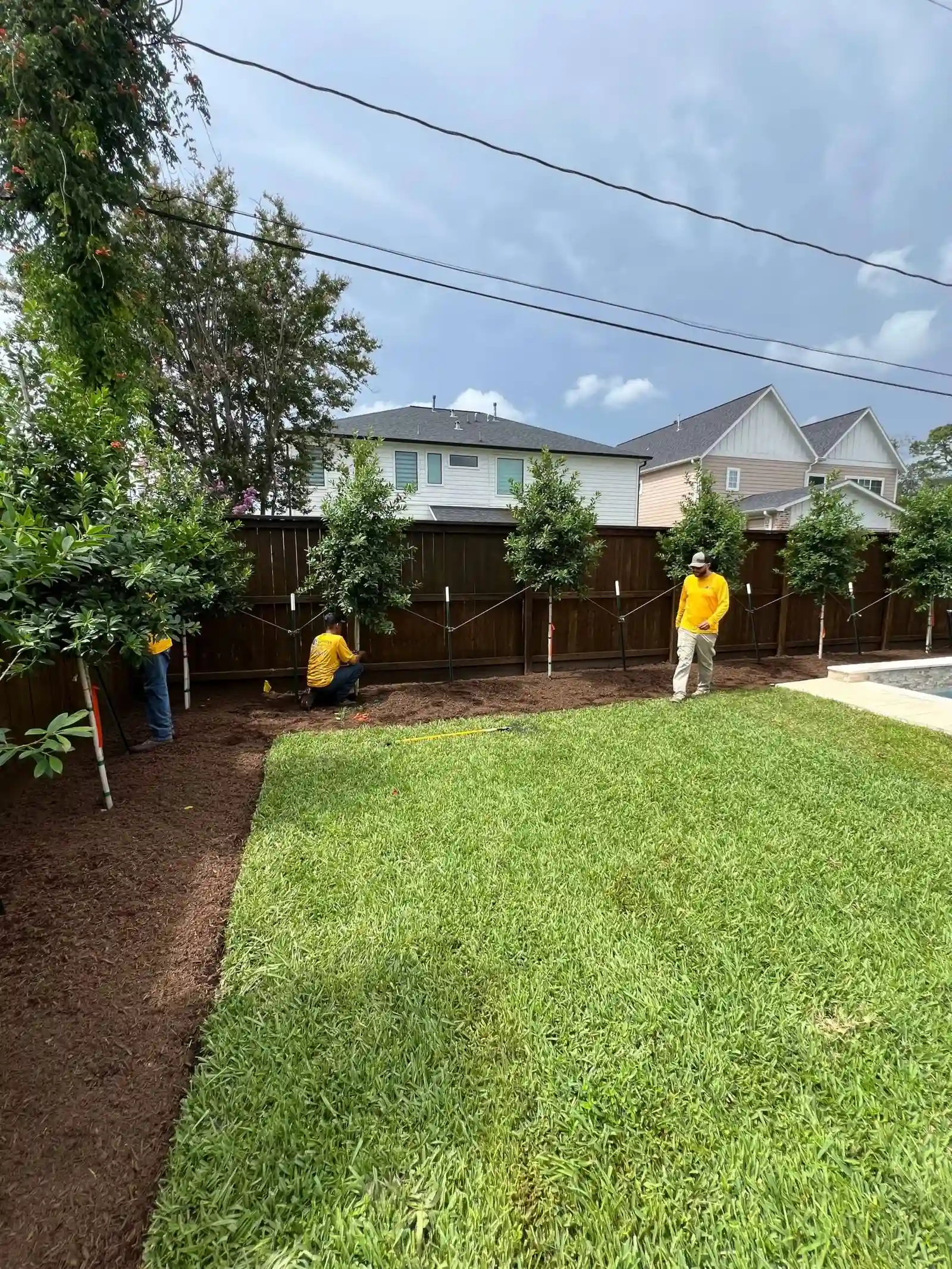 Houston's mature canopy trees — Live Oaks, Pecans, and Magnolias — require professional equipment and crews that national average pricing doesn't account for.
Bottom line before the detail: Tree trimming in Houston runs $150–$400 for small ornamentals, $400–$900 for mid-size trees, and $900–$2,500+ for large mature trees. But the real answer for your yard depends a few specific factors that no flat-rate quote can account for without seeing your property.
The pricing ranges on this page are general estimates based on typical Houston jobs and market conditions as of 2026. They are not a quote, not a bid, and not a guarantee of what your specific project will cost. Every property is different — tree species, size, access, site conditions, and the full scope of work all change the number. The only way to know what your trees actually cost is an on-site assessment. If you have a tree that may be diseased, structurally compromised, or near structures or power lines, consult a certified arborist before any work begins. This guide is provided for general education only and does not constitute professional advice or a contractor agreement.
National average data for tree trimming typically reflects mid-sized residential trees in general-climate regions — 30 to 40 feet, reasonable soil, good equipment access. Houston's context is meaningfully different in three ways that consistently push costs higher.
Houston's combination of heat, humidity, and year-round growing conditions produces some of the largest residential tree canopies in Texas. A Live Oak in Kingwood or Memorial Villages that's been established for 40 years routinely reaches 60–80 feet with a canopy spread exceeding 60 feet. That's not a tree you manage with a pole saw and a pickup — it requires a crew, aerial equipment, rigging, and multiple debris loads. The job doesn't fit a national average because the tree doesn't fit the national average.
Houston's established inner-loop neighborhoods — The Heights, Montrose, Bellaire, West U — have tight lots, narrow side setbacks, and gates that don't accommodate equipment. When an aerial lift can't reach the tree, the crew hand-carries equipment and works from ropes. That's skilled labor at higher cost per hour. It's not markup — it's the physics of access.
Tree work in Houston happens with the understanding that every large canopy tree is a potential liability claim in hurricane season. Professional crews that carry proper liability insurance, use rigging to control limb placement, and have experience working near structures in Houston's wind environment cost more than uninsured crews with a truck and a chainsaw. That premium is worth paying, and it's part of why local professional pricing runs above the national data.
These are representative project types with typical pricing from the Houston market. Exact pricing varies by access, debris volume, and site conditions — but these give you an honest baseline for what comparable scopes actually cost.
The same tree in an open backyard with wide gate access can cost significantly less than the same tree behind a narrow fence requiring hand-carry. When you're getting quotes, the question "how does your crew access the backyard?" will tell you whether the contractor has actually thought through the job — or is pricing off a photo.
The single largest cost variable. A 30-foot tree may often be handled from the ground, while a 70-foot Live Oak can require climbing, aerial equipment, rigging, multiple crew members, and substantially more time. Every additional 10 feet of height adds complexity and time in a non-linear way — the upper canopy is harder to work in, further from the chipper, and riskier to drop.
A tree in open grass is a simple chipping job. A tree with limbs over your roof requires rigging — a crew member at height placing ropes to control where each limb lands as it's cut. That's skilled work that adds significant time per limb. The closer the tree is to your structure, fence, or neighbor's property, the more control work is required.
Wide gate, open driveway access = aerial lift can get in = faster work = lower cost. Narrow gate, tight setback = hand carry = additional crew hours = higher cost. This is the factor most homeowners don't think to mention when getting quotes. Before any crew arrives, measure your gate width.
A 70-foot Live Oak with a 60-foot canopy spread produces an enormous amount of wood and leaf debris. Most jobs require a chipper on site and at least one full truck load of debris hauled out. Large trees can require multiple loads. Debris disposal is a real line item that low quotes often omit or underprice — then charge as an add-on after the work is done.
OSHA requires unqualified workers to maintain at least 10 feet from energized overhead power lines. Work within that distance requires trained line-clearance tree trimmers with specialized qualifications, and may require coordination with your utility provider. A crew that works near power lines without proper procedure is a liability — the premium for properly qualified line-clearance work is a legitimate cost, not padding.
An emergency call after a storm — hanging limb over the roof, blocked driveway, post-hurricane debris — commands a significant premium over the same scope done on a scheduled basis. Equipment is already committed elsewhere. Crews are running emergency routes. The urgency is real, and the cost reflects it. This is the most compelling argument for pre-season maintenance: scheduled work in the slower months can cost substantially less than emergency response during peak storm season.
| Tree Species | Typical Size Range | Cost Range (Standard Job) | What Affects Cost Most |
|---|---|---|---|
| Live Oak | 40–80 ft. at maturity | $600–$2,500+ | Massive canopy spread, frequent roof proximity in Houston lots, high debris volume. Houston's most expensive tree to trim properly at full maturity. |
| Crepe Myrtle | 15–30 ft. | $100–$350 per tree | Typically ground-level work. Cost is low per tree but bundles well. Improper pruning (topping) is free to do and very expensive to fix — it's worth paying for the correct technique. |
| Pecan | 40–60 ft. | $500–$1,400 | Wide canopy, heavy debris. Interior cleaning requires careful work to avoid damaging productive outer growth. Dormant-season timing is important for nut production. |
| Southern Magnolia | 40–70 ft. | $500–$1,600 | Dense, large-leaf canopy produces significant debris volume. Sensitive to over-pruning. Work must be matched to natural form or the tree looks bad for years. |
| Loblolly / Slash Pine | 50–90 ft. | $600–$2,000+ | Very tall, straight trunks with upper canopy that's difficult to access. Lower dead limb removal is simpler. Upper structural work requires aerial equipment and experienced crews. |
| Sabal / Queen Palm | 15–50 ft. | $75–$400 | Dead frond removal is typically quick and low-cost. The mistake that adds cost: over-trimming. Removing green fronds that didn't need to come off is work you paid for that damaged your tree. |
| Red / Water Maple | 30–50 ft. | $350–$1,000 | Fast-growing, aggressive branching. Frequently requires more frequent attention than slower-growing species. Soft wood means limbs break more easily under storm load — clearance work is important pre-season. |
| Chinese Tallow (Invasive) | 20–40 ft. | $200–$600 (trim) / $400–$1,200 (removal) | Invasive species. If it's in a difficult location, removal is often more cost-effective than repeated trimming. Confirm with a certified arborist before spending on ongoing maintenance of a species that will continue to spread. |
We'll walk your property, identify the priority trees, and tell you exactly what scope is needed — and what can wait. No upsell, no surprise add-ons after the work starts.
The biggest lever most Houston homeowners have on tree trimming cost is bundling. Here's the economic logic: the largest fixed cost on a tree job is equipment mobilization — getting a crew, aerial lift, chipper, and truck to your property. That cost is the same whether you trim one tree or five. When it's amortized across multiple trees, the per-tree cost drops significantly.
A single medium Live Oak trimmed as a standalone job might quote at $700. That same tree, quoted as part of a 4-tree pre-storm-season package, might price at $450 — because the mobilization cost is already covered by the other three trees. Homeowners who schedule one tree at a time, year after year, consistently pay more per tree than those who do a full property pass every 2–3 years.
A full property trim before the spring growth flush and before hurricane season is the highest-value tree maintenance investment you can make in Houston. You get the best pricing (scheduled work, not emergency response) and you arrive at storm season with a properly prepared canopy. For oak species, time structural pruning outside the February–June oak wilt risk window — a certified arborist can advise on safe timing. Defer any tree work to peak storm season and you'll pay more for worse timing.
Tree trimming is rarely the only thing happening on a property that needs tree work. The total invoice often depends on related services that are scope-dependent — meaning the price is driven by the size of the tree, the access to the site, the volume of debris, and the specific conditions of your property. There is no flat rate for any of these because there is no flat scenario. Here's what to expect and what drives each one.
If a tree is being removed (not just trimmed), the stump is a separate scope. Stump grinding in Houston typically runs $150–$500 per stump (2026 estimates) depending on stump diameter, depth of grind, and whether surface roots need to be addressed. A small stump (under 20 inches) with easy equipment access can be on the low end; a large stump with extensive surface roots and tight access is on the high end. The equipment is already on site if you're combining tree work with stump grinding, which is why bundling these services saves on mobilization. See our stump grinding vs removal guide for the full breakdown.
Trimming a large tree produces a significant volume of wood and leaf debris. Standard tree trimming quotes typically include chipping and hauling of the debris generated by the trim itself. But if you want the wood chips left on site for mulch, or if you have existing brush, fallen limbs, or old debris that also needs to go, that's additional hauling — typically $75–$300 per load (2026 estimates) depending on volume and how far the truck has to travel to dispose of it. The variables: how much debris, how easy is it to reach, and how many loads it takes.
After a stump is ground out or a large root system is removed, you're often left with a depression or uneven ground. Adding soil to level the area is a separate scope — typically $150–$600 (2026 estimates) depending on the size of the void, the amount of soil required, whether the soil needs to be amended for planting, and whether grading or compaction is needed. A small stump hole topped with a few bags of topsoil is minimal; a large stump removal with a full area regrade and sod prep is significantly more. This is entirely dependent on what you want the area to look like when it's done — lawn, bed, or hardscape all have different prep requirements.
Stump grinding, debris hauling, and soil leveling are each driven by different variables — stump diameter, debris volume, and soil/grading needs. A flat-rate quote that rolls them all together is either guessing or padding. The honest approach is to assess each scope on your property and price it based on what's actually there. When you request an assessment, ask for these services to be itemized so you can see exactly what each line costs — and decide which ones you want done.
Before any tree work begins, check two things: your local municipality's tree ordinance and your HOA's architectural guidelines. Some Houston-area cities require permits for tree removal above a certain trunk diameter, and many HOAs restrict which species can be removed, how much canopy can be trimmed, and when work can be performed. Protected or "heritage" trees — often defined by trunk diameter — may require a permit even for trimming. Fines for unpermitted work can exceed the cost of the job itself. You, the property owner, are responsible for confirming compliance; a contractor's quote does not guarantee permit approval. If you're unsure, your city's planning or arborist office is the right first call.
Honestly, a lower quote can absolutely work out fine. If the job is straightforward, the tree is small, and the crew has been recommended by someone you trust — price isn't the only signal of quality. Most people have had a perfectly good experience with a local crew that charged less than a larger company would have. That's real, and we're not going to pretend otherwise.
Where it tends to get complicated is when the gap between quotes is significant and the scope isn't spelled out clearly. A few things worth keeping in mind when you're comparing:
Two quotes for the same tree can vary a lot based on technique. A crew planning to top the tree — cutting major limbs back to stubs — will almost always come in cheaper than one doing proper reduction cuts. Topping is faster. It also tends to leave the tree in worse shape within a couple of seasons, with denser, weaker regrowth and large wounds that don't seal cleanly. Not every homeowner needs to care about the long-term arc of a tree's health — but if you're planning to be in this house for a while, it's worth asking how the work will be done, not just what it will cost.
If there's going to be a crew working in your yard near your home, asking for proof of general liability is completely normal. Most established crews have it and will share it without hesitation. It's less about distrust and more about the practical reality that tree work near structures carries real risk, and you just want to know that risk is covered. For homeowners who care about that kind of accountability, it's a 30-second question that answers a lot.
A quote that lays out what's being cut, how debris is handled, and how they'll access the backyard is one where someone has walked through the job in their head. A number without that detail isn't always a problem — but it can leave room for surprises after work starts. For anything over a structure or involving a large mature tree, getting the scope in writing tends to make the whole job go smoother for everyone involved.
Timing affects tree trimming cost in two ways: the market rate at different points in the season, and the risk premium of emergency versus scheduled work.
Scheduling tree work in the slower winter months — when demand is lower, crews are more available, and turnaround from quote to job is faster — typically gets you the best rate and the most flexible scheduling. But ideal pruning timing varies by species and tree condition, and Texas oaks require special precautions. Texas A&M Forest Service recommends avoiding pruning or wounding oak trees from February through June because of oak wilt risk, and advises immediately painting all oak wound surfaces regardless of season. If you have Live Oaks or red oaks on your property, time structural pruning outside that high-risk window or consult a certified arborist. For non-oak species, late dormancy is generally the optimal window for structural pruning. For a full breakdown of timing by species and goal, see our Houston tree trimming timing guide.
As hurricane season progresses and storm events trigger awareness, demand for tree work spikes. Crews are booked out further, mobilization is prioritized toward emergency work, and standard scheduling jobs wait longer. The price itself may not change dramatically, but availability decreases and the urgency premium on any complicated job goes up. Pre-season work is the antidote to storm-season pricing pressure.
A hanging limb over your roof after a storm is an emergency. Emergency pricing reflects real constraints — the crew drops other work, responds immediately, often works in conditions (wet, windy, post-storm) that add risk and difficulty. The same scope that costs $800 as a scheduled job can cost substantially more as an emergency call. This is not price gouging — it's the economics of urgent reallocation. The best way to avoid it is to not need it.
Storm-damaged trees are fundamentally different from routine trimming. A limb under tension, a partially uprooted trunk, or a tree leaning against a structure can release unpredictably when cut. This is the single most dangerous category of tree work, and it requires a crew with specific hazard-tree training, rigging experience, and proper insurance. A crew that treats a post-storm hazard tree like a normal trim is a liability to themselves and your property. If a tree on your property is actively threatening a structure after a storm, do not attempt to cut it yourself, do not let an unverified crew start cutting, and do not assume the first door-knocker is the right call. Get a hazard assessment from a qualified crew or certified arborist before any cutting begins.
Tree trimming in Houston runs $150–$400 for small trees under 25 feet, $400–$900 for medium trees 25–50 feet, and $900–$2,500+ for large mature trees over 50 feet. Cost is primarily driven by tree height, access difficulty, proximity to structures, and debris volume. Multiple trees trimmed in one visit reduce the per-tree cost considerably.
Houston has some of the largest residential tree canopies in Texas, particularly mature Live Oaks and Pecans that frequently reach 60–80 feet. Limited access in urban Houston lots, frequent aerial lift requirements, and the liability exposure of working near structures in a hurricane-prone region all contribute to costs that run above national averages for comparable scope. Professional crews with proper insurance and storm-season experience are the correct standard here — and that's reflected in pricing.
Yes, significantly. Equipment mobilization is the largest fixed cost on any tree job. When equipment is already on site for one tree, adding additional trees reduces the per-tree cost considerably. Homeowners who bundle 3–5 trees in one visit typically pay less per tree than scheduling each separately. A pre-storm-season bundle is the highest-value tree care investment in Houston.
Most contractors use the terms interchangeably. Technically, trimming refers to clearance and shape maintenance, while pruning refers to health-focused structural cuts. A professional scope includes both: clearance work where the tree is encroaching on structures, and structural cuts to improve long-term canopy health and storm resistance. When getting quotes, ask what's included — the distinction matters less than confirming the full scope is covered.
Routine tree trimming is not covered — it's maintenance. However, if a tree falls and damages a structure during a storm, the structural damage is typically covered under your dwelling coverage. Emergency hazard removal of a tree actively threatening your home may also have coverage implications. Review your specific policy or contact your carrier for your exact terms — coverage varies significantly by insurer and policy type.
A fair quote accounts for tree height and canopy spread, limb diameter and count, access method, proximity to structures, debris disposal, and crew size. A quote that doesn't ask about these factors before providing a number is either a flat-rate guess or missing scope. Get 2–3 quotes for large trees, compare scope line by line (not just total price), and verify insurance before approving any work over your structure.
Not always — and this is a common source of confusion. Standard tree trimming quotes typically include chipping and hauling of the debris generated by the trim itself. Stump grinding (if a tree is removed), hauling of pre-existing brush or old debris, and soil addition to level the area after stump removal are separate scopes priced based on stump size, debris volume, and the amount of soil and grading needed. Each is dependent on your specific site conditions and access. Always ask for these to be itemized in your quote so you know exactly what's included and what's additional.
Evergreen Outdoor Services publishes this guide for general educational purposes only. All pricing ranges are estimates based on typical Houston market conditions as of 2026 and are not a quote, bid, or guarantee of actual cost. Final pricing is determined only after an on-site assessment of your specific trees, access, site conditions, and requested scope. Tree work involves inherent risk; property owners are responsible for verifying that any contractor they hire carries appropriate general liability insurance, and for confirming that a certified arborist has evaluated any tree with potential health, structural, or safety concerns. Evergreen Outdoor Services is not liable for decisions made based on the information in this guide. For a scope-specific quote for your property, request a tree trimming quote.
We'll walk your property, review the trees in your requested scope, and give you a scope-specific quote — not a number from a price sheet. No surprise add-ons. No uninsured crew. No topping.
Call us at 832-506-8239 or request your tree trimming quote online.