Trees are often the most valuable landscaping assets on a Houston property, providing shade against our intense heat and stability for our soil. However, between our heavy gumbo clay soils, sudden droughts, and hurricane-season winds, even sturdy trees can become liabilities.
Identifying a failing tree early isn’t just about aesthetics; it is about protecting your home and family. While preservation is always our first goal, understanding the warning signs of structural failure can save you from an emergency situation later.
If you spot these urgent indicators, do not wait for the next storm to act:
Not every damaged tree needs to come down. Professional arborists use a "Risk vs. Value" assessment to decide. Here is a general breakdown of how we classify tree issues.
Industry standard: Tree risk assessments are commonly guided by ISA’s Tree Risk Assessment Qualification (TRAQ) framework. Learn more about ISA TRAQ
| Condition | Pruning / Cable Bracing | Removal | Emergency Removal |
|---|---|---|---|
| Dead Wood | Small dead limbs (<2 inches) can be pruned. | More than 50% of the tree is dead. | A dead limb is hanging over a roof or driveway. |
| Lean | Grown at a slight angle naturally over years. | Tree has recently shifted; soil cracking. | Leaning toward structure + exposed roots. |
| Trunk | Minor bark damage or small wounds. | Large hollow cavities or extensive rot. | Fresh, deep vertical crack in main trunk. |
What you’ll notice: Look at the ground where the trunk meets the soil (the root flare). If you see the earth lifting up on one side opposite a lean, or if construction/trenching has recently cut through major roots.
Why it matters: Roots provide the anchor. In Houston’s clay-heavy soil, root rot from poor drainage is common. If the anchor is compromised, the tree will fall, regardless of how healthy the leaves look.
What you’ll notice: A tree that wasn't leaning last month is leaning now. Or, a tree that has always leaned slightly has increased its angle (more than 15 degrees is often the threshold for concern).
Why it matters: Trees act as sails in the wind. A sudden lean indicates the roots have snapped or the soil has liquified.
What you’ll notice: Deep fissures running up and down the trunk or along major scaffold branches.
What to do next: If the crack is on a branch, pruning might save it. If it is on the main trunk, removal is likely necessary.
What you’ll notice: Holes in the trunk where bark is missing, or areas that look solid but sound hollow when tapped with a mallet.
Why it matters: A tree can live with a hollow trunk (the living tissue is on the outside), but its structural integrity is compromised. If the outer shell is too thin to support the canopy weight, the trunk can buckle.
Why it matters: Fungal growth on the trunk or at the base is a strong warning sign of internal decay. While you can’t see the rot from the outside, mushrooms/conks often show up when wood inside the tree is breaking down—meaning the tree’s structure may already be compromised.
Why it matters: Fungi do not grow on healthy wood; they feed on decaying matter. If you see fungus on the outside, it guarantees there is rot on the inside.
What you’ll notice: The tree looks healthy at the bottom, but the very top branches are bare, brittle, and look like antlers (stagheading).
Why it matters: This usually signals that the tree is retrenching—it no longer has the root energy to support the upper canopy.
What you’ll notice: Branches are rubbing against your roof shingles, or the trunk is growing within inches of your foundation.
Safety Warning: Never attempt DIY trimming near power lines. This is fatal. Only certified professionals utilizing specialized equipment should work near utilities.
What you’ll notice: Tiny sawdust piles (frass) at the base of the tree, small exit holes in the bark, or excessive sap oozing from the trunk.
What to do next: Isolate the tree to prevent spread to other trees on your property. Removal is often the only option for advanced infestations.
What you’ll notice: The aftermath of a hurricane or severe thunderstorm leaves the tree with a broken canopy, twisted limbs, or a split crotch.
Why it matters: A storm-damaged tree safety assessment is vital because "hangers" (broken branches caught in the canopy) can fall days or weeks after the storm passes.
While any tree can fail under the right conditions, three species in the Greater Houston area keep our crews busiest due to their specific biological weaknesses.
When you request a quote, you might wonder why one tree costs significantly more to remove than another of the same size. It usually comes down to access and targets.
We assess the "Drop Zone"—the area where we can safely lower branches. The more complex the environment, the more technical (and time-consuming) the removal becomes.
We take property protection seriously. For projects that require heavier equipment—or when ground conditions are soft—we may use ground protection mats to help reduce ruts and protect turf, driveways, and other hardscapes. Many smaller jobs don’t require mats, but we’ll always choose the right level of protection based on the scope and site conditions.
High-risk season: In Texas, it’s best to avoid pruning or wounding oak trees from February through June. That’s when sap-feeding beetles are most active, which can increase the risk of oak wilt spreading.
Authority reference: Texas A&M Forest Service — Pruning tips to prevent the spread of oak wilt
If a cut happens anyway: Storm damage and emergencies don’t always wait. If an oak must be cut—or a fresh wound is exposed—seal the wound promptly with a thin coat of pruning paint (or latex paint) to help reduce infection risk, regardless of the season.
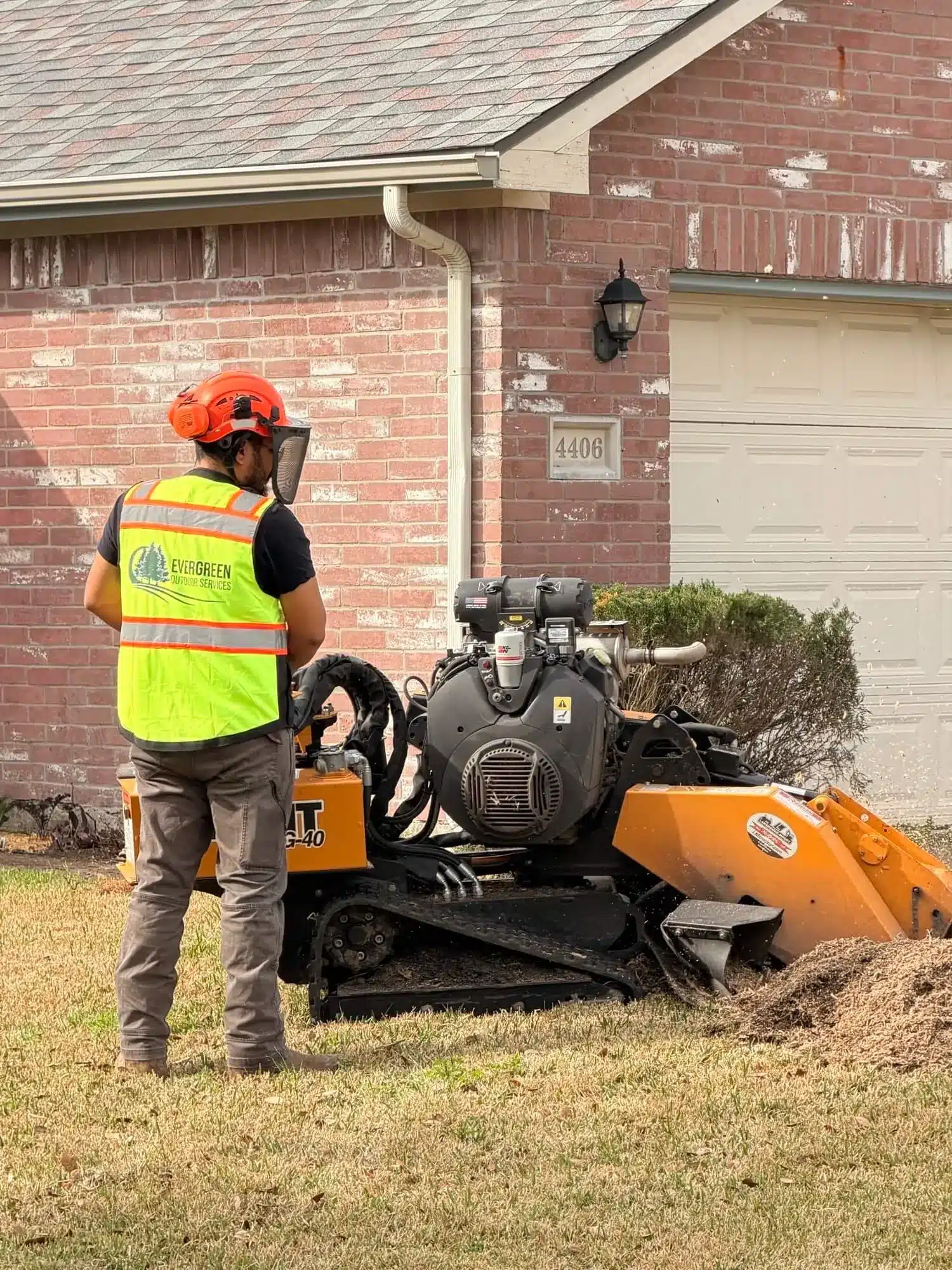
Once the tree is removed, you’ll be left with a stump—and that’s where a lot of homeowners get surprised. A stump isn’t just “cosmetic.” It can look out of place, make the yard feel smaller, and break up that open, clean lawn look.
Practically, it also creates headaches: it’s a tripping hazard (especially for kids running around), it’s hard to mow around, and it can attract pests or fungi as it slowly decays. In some yards, surface roots can even continue to heave or create uneven ground over time.
If your plan is to replant, lay sod, or simply get the area back to a smooth, mowable lawn, stump grinding is usually the next step. It removes the stump below grade so you can restore the area cleanly—without turning it into a bigger project than it needs to be.
If you aren't sure if your tree is a beauty or a beast, don't guess. Our team can provide a clear, honest assessment of the tree's health and structural integrity.
Request A Tree Safety Assessment